

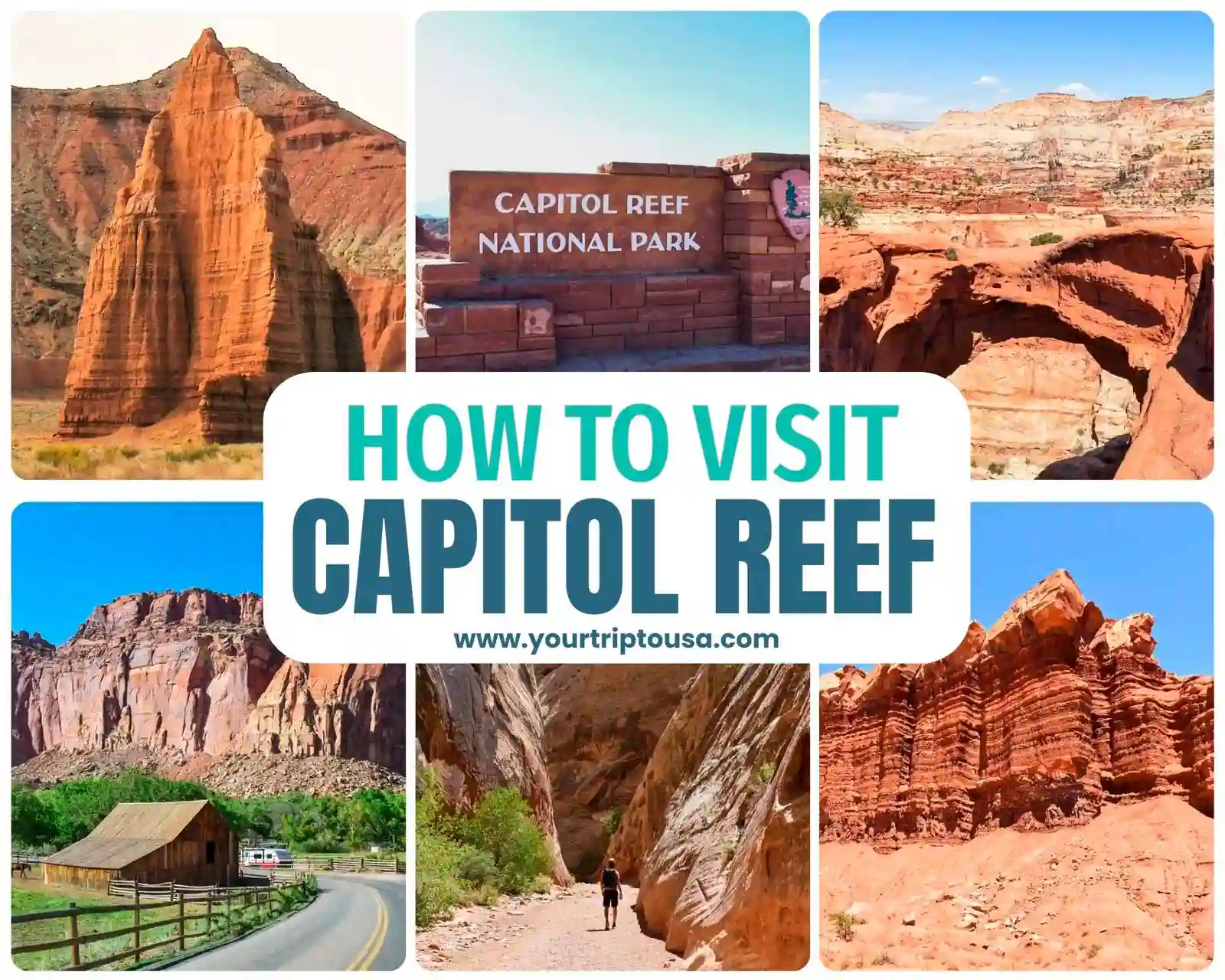
Where is Capitol Reef?
Capitol Reef National Park is located in southern Utah, near Escalante and less than a 4-hour drive from Salt Lake City. It is a very wild area with hardly any towns; the nearest ones are Torrey to the west and Hanksville to the east, but they are very small.
Here are the distances to a few cities and destinations to give you an idea:
- Torrey (Utah): 12 miles or 19 km (15 min)
- Hanksville (Utah): 38 miles or 61 km (50 min)
- Escalante (Utah): 80 miles or 120 km (1:45 h)
- Bryce Canyon NP (Utah): 117 miles or 189 km (2:15 h)
- Moab (Utah): 147 miles or 236 km (2:30 h)
- Zion NP (Utah): 183 miles or 294 km (3:05 h)
- Salt Lake City (Utah): 221 miles or 355 km (3:40 h)
- Page (Arizona): 260 miles or 418 km (4:35 h)
- Las Vegas (Nevada): 334 miles or 538 km (5:15h)
- Phoenix (Arizona): 505 miles or 812 km (8:30 h)
What are the closest airports to Capitol Reef?
The closest airport to Capitol Reef National Park is Salt Lake City, which is a 3.5-hour drive from the park.
What are the access points to Capitol Reef?
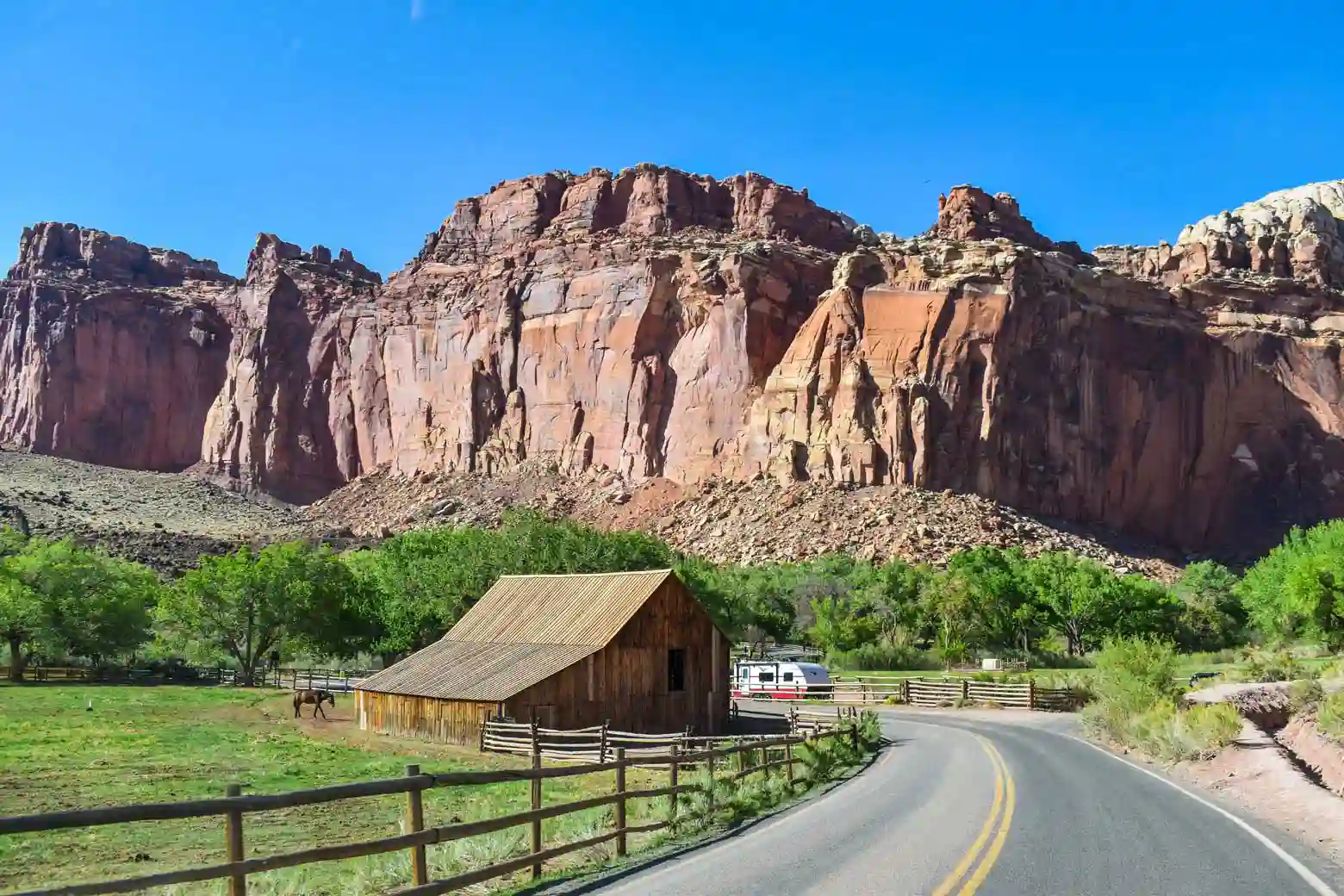
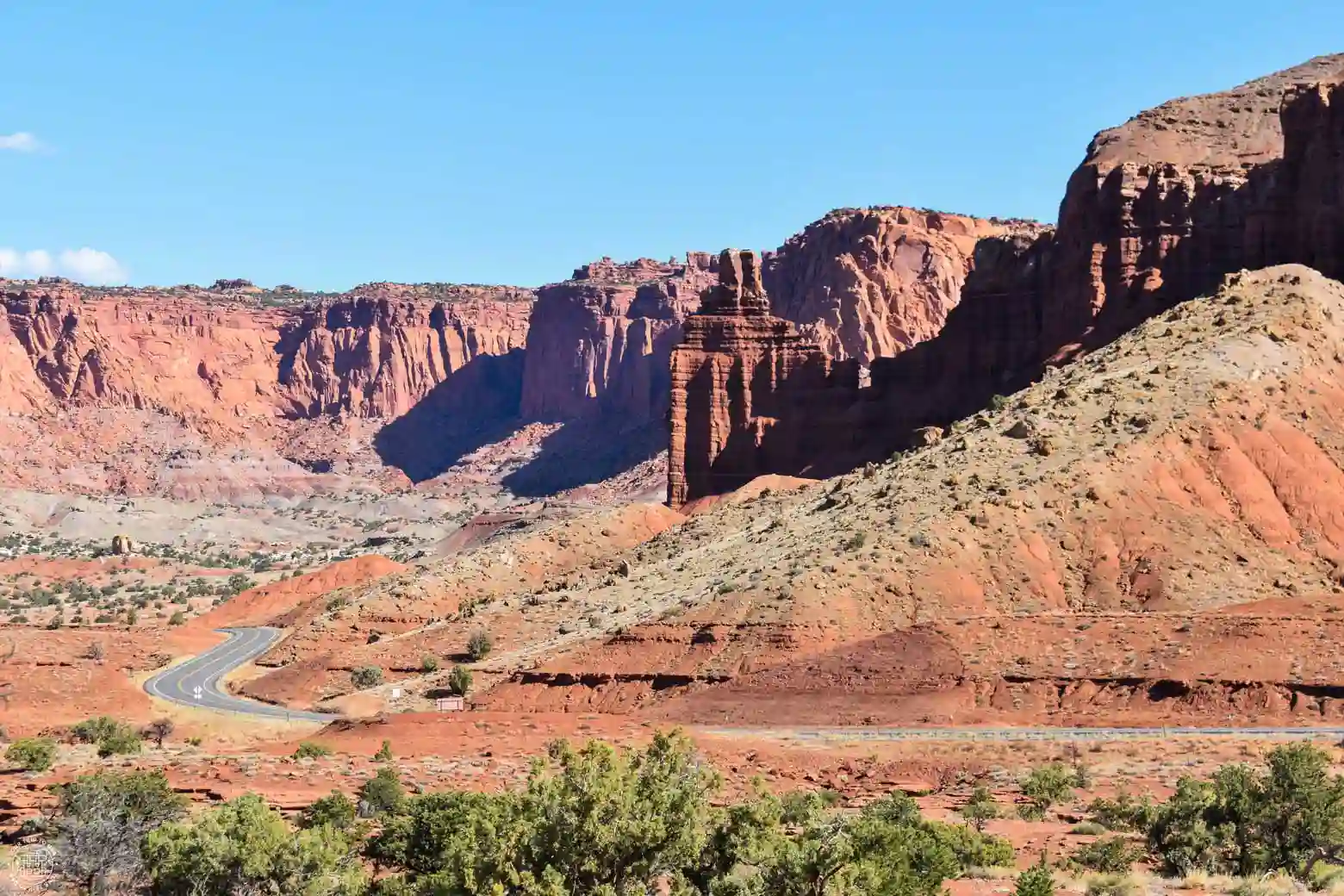
The main entrance to Capitol Reef National Park is located in the former Mormon town of Fruita, situated on State Route 24 between the towns of Torrey and Hanksville. Several secondary roads in varying conditions branch off from this route and cross the park. You can drive along Route 24 between Torrey and Hanksville without having to pay the park entrance fee.
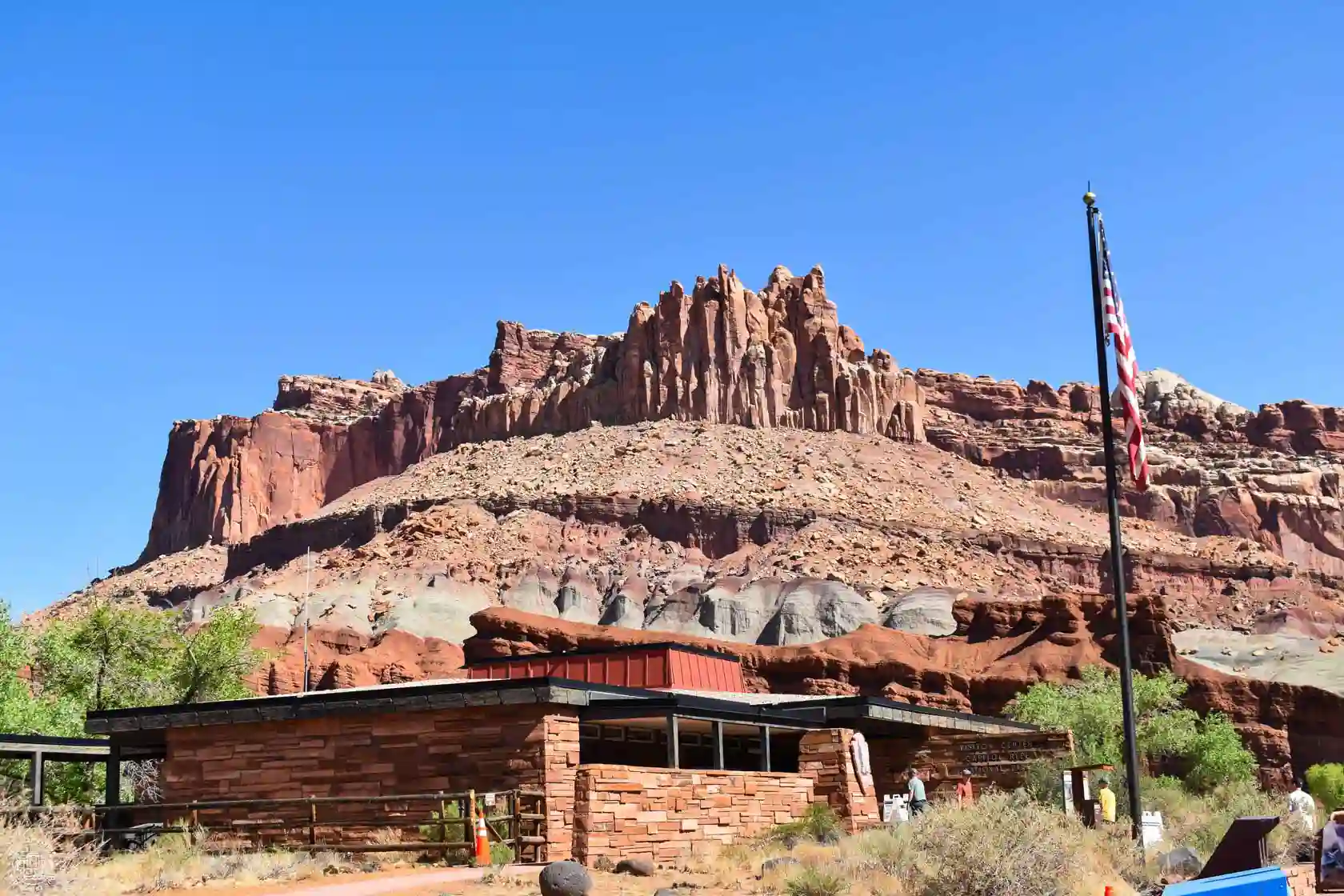
Fruita is home to the visitor center, the campground, and the national park's main services, as well as the starting point of the Scenic Drive, the nature reserve's main road, which takes you to some of the most famous tourist attractions.
Secondary Roads in Capitol Reef
To the north of Highway 24, Cathedral Road and Hartnet Road branch off; these roads require a high-clearance 4x4 to navigate. These routes lead to a series of spectacular overlooks in the middle of the desert, such as Temple of the Sun, Temple of the Moon, Lower South Desert Overlook, Upper South Desert Overlook, and Upper Cathedral Valley Overlook. In Cathedral Valley, the two roads meet, allowing you to drive a loop.
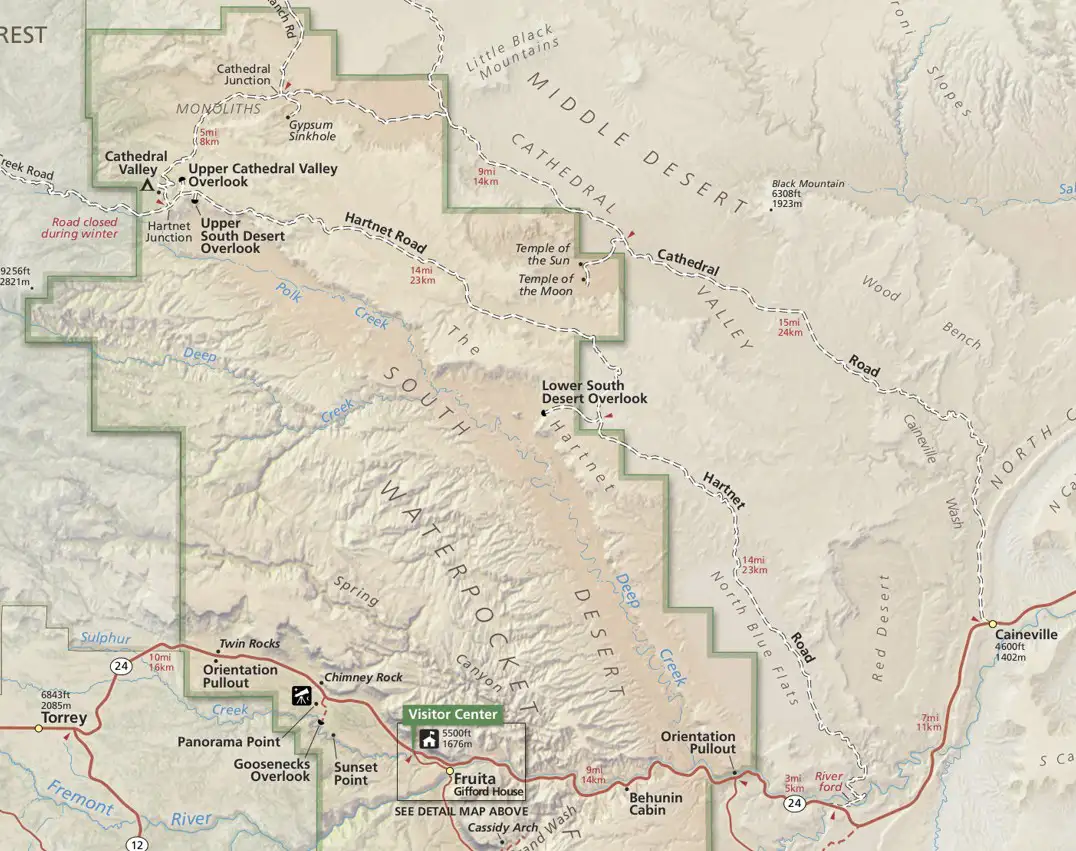
To the south of Highway 24, Notom-Bullfrog Road branches off, crossing Strike Valley and allowing you to enjoy the incredible Waterpocket Fold. The first 15 miles (24 km) are paved, and the next 17 miles (30 km) are an unpaved route that connects to Burr Trail Road. This other road, 35 miles (56 km) long, runs from the town of Boulder through Long Canyon and crosses the park from west to east, ending at the Waterpocket Fold. The 5 miles (8 km) of Burr Trail Road within the park are unpaved, while the rest is paved; in principle, a 4x4 is not required to drive this route.
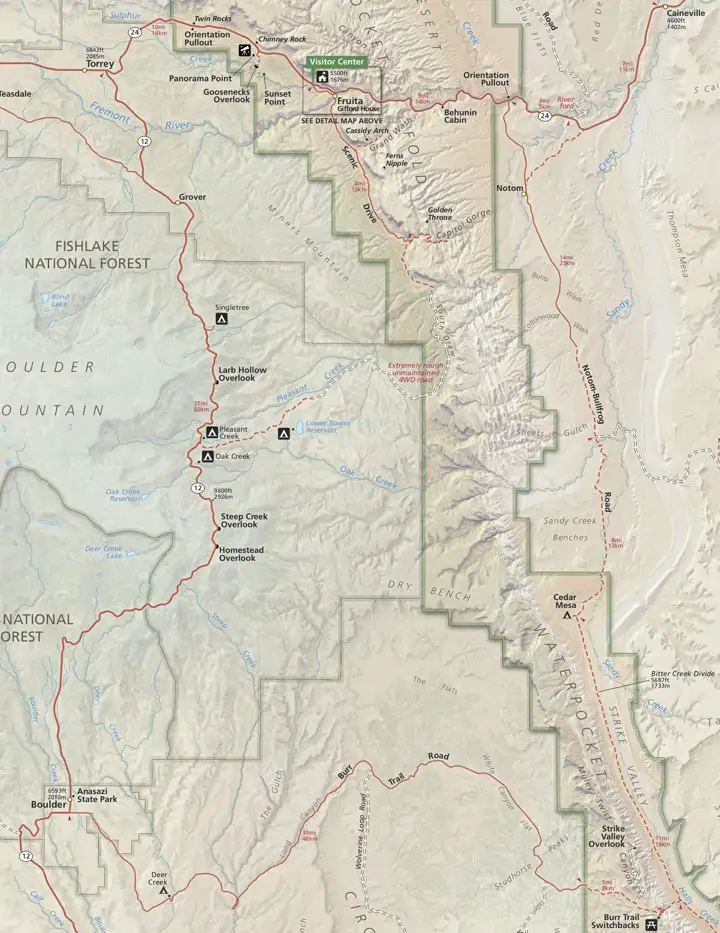
After the intersection of Burr Trail Road and Notom-Bullfrog Road, the latter continues south to Bullfrog Marina, within the Lake Powell National Recreation Area. The first 3 miles (5 km), up to the park boundary, are unpaved, and after that, the road is paved except for the Bullfrog Creek ford.
How to Get Around in Capitol Reef
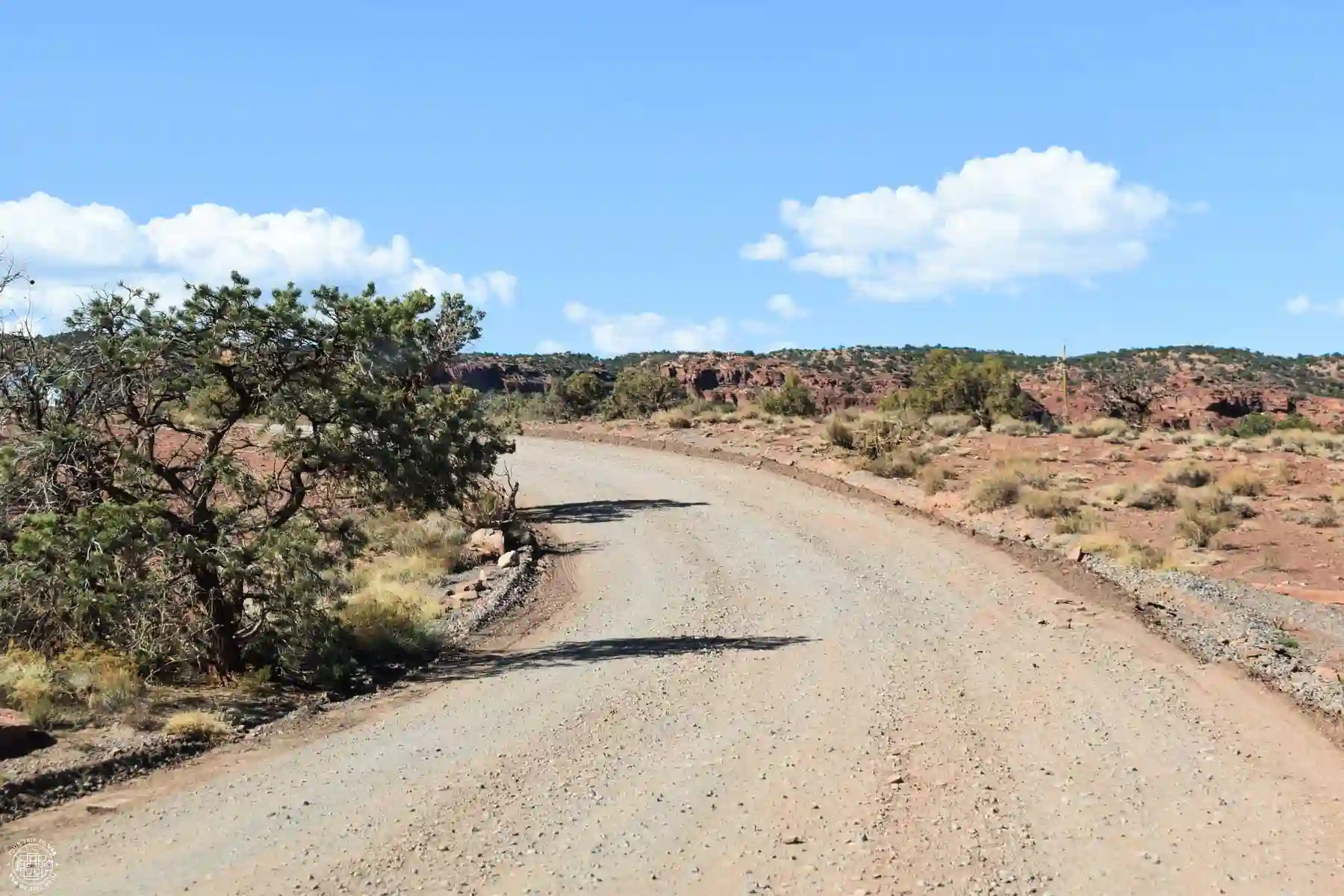
The best way to get around Capitol Reef is to combine walking with a private car, since there is no public transportation within the national park. In some areas, a high-clearance 4x4 is essential, as some roads are not maintained.
⚠️ Please note that during peak season, you may have trouble finding parking in the Grand Wash or Capitol Gorge area, as the parking lots are small.

TRAVEL INSURANCE
FOR THE UNITED STATES
💸 Healthcare in the U.S. is very expensive, and any accident or illness can cost you a fortune.
That's why we recommend getting travel insurance that covers you in case anything goes wrong, so you don't have to pay anything up front.
💡 We always travel with Heymondo because it offers excellent medical coverage at a great price. Plus, you can get 5% OFF*!
🤓 Take a look at: Best travel insurances for the USA | Comparison + Discounts |
How to Get to Capitol Reef
Capitol Reef National Park is located in a remote area in southern Utah, but right along State Route 24, which connects Bryce Canyon and Zion National Parks in the western part of the state with the town of Moab in the east, home to Canyonlands and Arches National Parks. The main access point is the old town of Fruita, where you’ll find the Visitor Center, a campground, and several historic buildings.
Most people visit the park as part of a tour of southern Utah or a 3-week road trip along the West Coast of the United States (coming soon), since getting here takes time. For this reason, most people arrive from Moab or Goblin Valley to the east, or from Bryce Canyon or Escalante to the west.
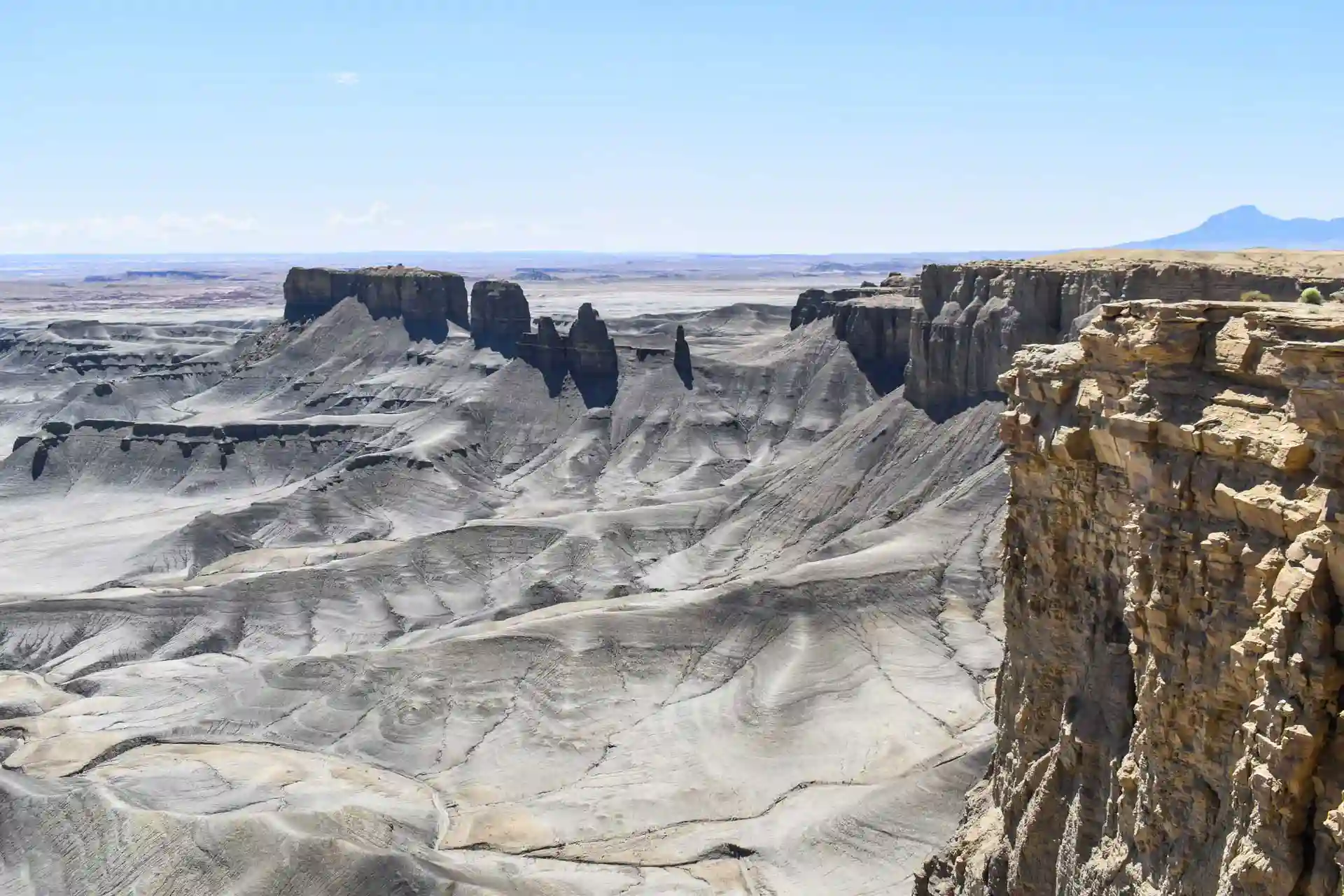
Although this is a remote part of the state, aside from the national parks we've already mentioned, it's full of natural wonders. Just a few miles away, you'll find beautiful places that look like they're from another planet, such as Factory Butte, Long Dong Silver Spire, Bentonite Hills, and Goblin Valley State Park.

RENT A CAR IN THE UNITED STATES
The best way to explore the United States is by car, giving you the freedom to travel at your own pace.
🚗 Whether you’re looking for a convertible Mustang, a 4x4, or a regular car, we recommend to book through this car rental search engine
💸 This is where we find the best prices, both on the rental car itself and on full coverage insurance!
How much is admission to Capitol Reef?
The standard admission price for Capitol Reef National Park varies depending on your mode of transportation:
- Cars, RVs , and vans with up to 15 seats: $20 per vehicle. This fee covers all passengers traveling in the vehicle.
- Motorcycle: $15; covers 2 motorcycles and up to 4 passengers.
- On foot or by bike for people 16 and older: $10 per person.
💡Recommended: Tips for Traveling Along the U.S. West Coast
This ticket grants you access to the park for 7 consecutive days and can only be purchased at the Visitor Center. 💸 Both credit cards and cash are accepted, so we recommend reading our article on the best credit cards for traveling to the United States to avoid fees.
There are also a number of passes that already include admission to Capitol Reef National Park; if you have any of them, you won't have to pay anything extra:
- Annual Entrance Pass: $35, which grants you unlimited admission to the park for 12 months. Available only to U.S. citizens and residents.
- America the Beautiful Pass: $80, granting you access to all U.S. national parks and other natural areas for 12 months. Available only to U.S. citizens and residents.
- America the Beautiful (Non-Residents): $250, granting you access to all U.S. national parks and other natural areas for 12 months. For non-residents only.
When to Visit Capitol Reef
The park is open year-round, although due to its climate and geographic location, some times of year are better than others for visiting. It lies at an elevation of between 5,000 and 7,000 feet (1,600 and 2,100 m) above sea level in an arid region; the climate in Capitol Reef National Park is dry, and rainfall is very scarce.
The rainiest months are usually July and August, during the monsoon season in the area, which can occasionally bring afternoon thunderstorms.
🪻 Visiting Capitol Reef in the Spring
Spring is the ideal time to visit Capitol Reef, especially in April and May, when daytime highs range from 68°F to 86°F (20°C to 30°C) and nights are cool, ranging from 39°F to 57°F (4°C to 14°C). Visitor traffic is heavy, and you may find the parking lots full—so you’ll have to get an early start! Also, between March and May, the old orchards in the town of Fruita are in bloom, and you can see the trees in full bloom.

INTERNET IN THE UNITED STATES
💡 The most convenient way to get internet access in the U.S. is to buy an eSIM—that way, you'll have a connection as soon as you set foot in the country. Plus, local SIM cards in the U.S. are pretty expensive.
💸 We have 2 discounts for your unlimited data eSIM for the US:
⭐5% OFF with Holafly ➡️ Excellent coverage
⭐20% OFF with eSIMFlag ➡️ Best price
🤓 Take a loot at: Best SIMs & eSIMs for traveling to the USA
☀️ Visiting Capitol Reef in the summer
June, July, and August are the hottest months of the year, with highs typically ranging from 84°F to 97°F (29°C to 36°C), though on some days temperatures can even reach 104°F (40°C). Nights are cooler, with temperatures usually ranging from 57°F to 70°F (14°C to 21°C). Especially in July and August—the rainiest months of the year— there is a chance of afternoon thunderstorms, which can cause flash floods.
If you plan to go hiking, be sure to stay well-hydrated and bring up to 1 gallon (4 liters) of water per person per day; at the visitor center, you’ll find drinking fountains where you can refill your bottles. Be especially mindful of afternoon thunderstorms, as they can pose a real danger; you can check the risk on this website.
🍎 During these months, some of the fruit trees have already borne ripe fruit, which is now ready to be picked. You can enter the orchards, pick your own fruit, and then pay for it at the self-checkout station.
🍂 Visiting Capitol Reef in the Fall
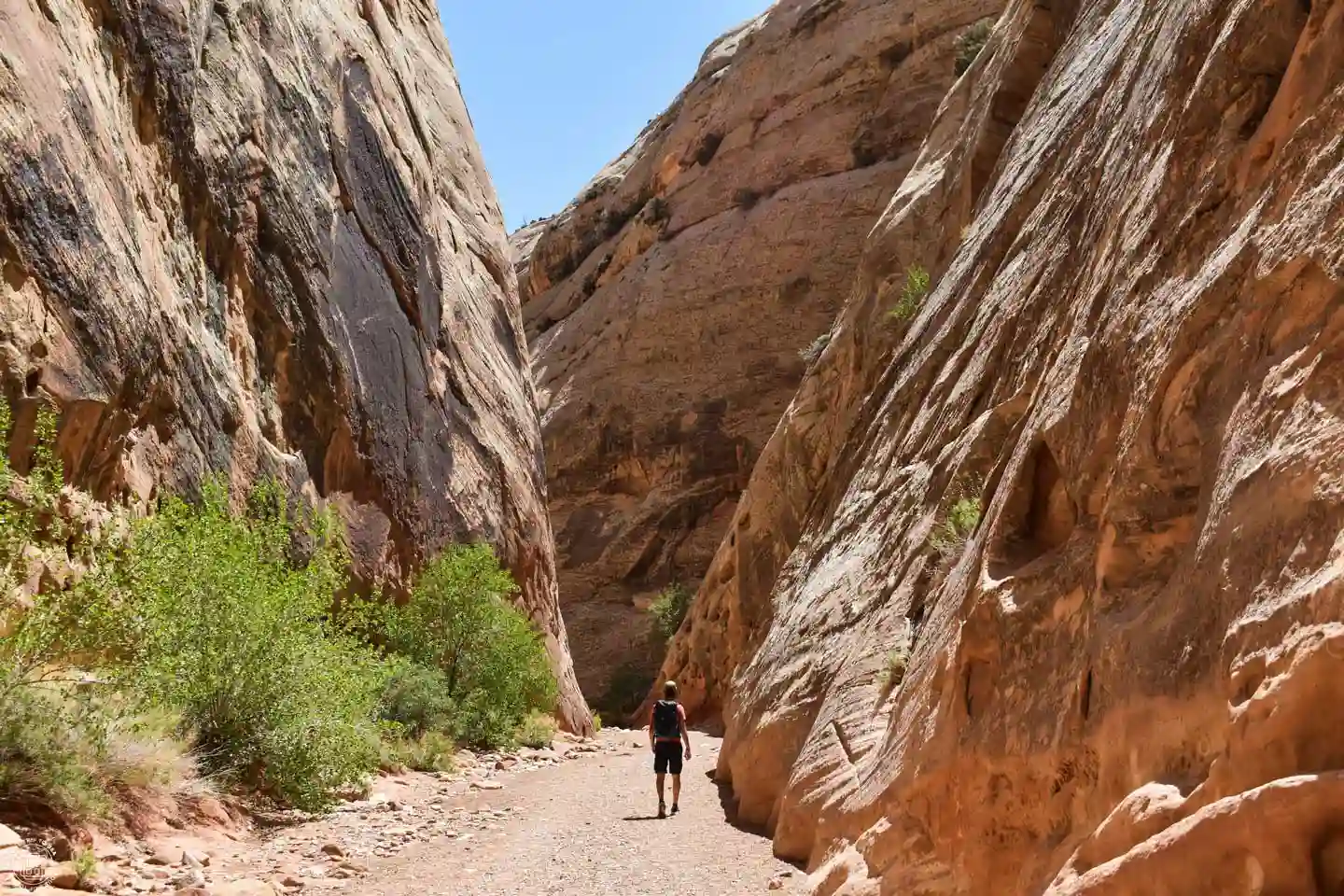
Fall is once again a great time to visit Capitol Reef; during these months, visitor numbers rise again thanks to the more pleasant weather, which is especially ideal for hiking.
Temperatures drop rapidly during September and October, from a high of 90°F to 61°F (32°C to 16°C) and a low of 61°F to 36°F (16°C to 2°C). Parking lots are once again packed with cars, and it’s still possible to pick some of the later-ripening fruits from the orchards.
❄️ Visiting Capitol Reef in Winter
During the winter months, the park enters a state of slight dormancy, as visitors practically disappear, temperatures drop sharply, and it is even common for there to be some snowfall due to the park’s high altitude.
From November through February, high temperatures rarely exceed 50°F (10ºC), and overnight temperatures can drop as low as 14°F (-10ºC), especially in January and February. Some roads and trails may be closed due to snow and ice.
 NO FEES CARD FOR THE UNITED STATES
In the U.S., you'll pay for almost everything by card. If you use one from your regular bank, you'll get hit with a ton of currency conversion fees.
💡 That's why we recommend to get the Wise card. There's no maintenance fee, and you can:
💸 Withdraw $250/month in any currency with no fees
💳 Do payments in any currency with no extra fees
Where to Stay in Capitol Reef
Since this is a remote area in southern Utah, lodging is limited in the vicinity of the national park, and the only option inside the park is to stay at the campground. Some of the nearby towns where you can find lodging options include Torrey, Caineville, and Hanksville.
🏨 Since this is an important topic, we've written a special post about the best hotels in Capitol Reef National Park.

🚐 The U.S. is a paradise for traveling by camper van or motorhome: there are plenty of campgrounds, wonderful places to stay overnight for free, and amenities around every corner.
If you'd like to try this way of traveling, the United States is the place to do it!
💸 And you can save a lot of money on lodging and food!
➡️ We always book through this rental search engine because they work with all the companies and have great deals.
How many days to spend at Capitol Reef
In our opinion, one day is enough to visit the main area of Capitol Reef, especially if you don't have a 4x4.
If you have a high-clearance 4x4 vehicle, you’ll be able to access other areas such as the Temple of the Sun, Temple of the Moon, and Cathedral Valley overlooks, since the roads leading to them are not maintained. You’ll also be able to tackle the unpaved sections of Nottom-Bullfrog Road and Burr Trail Road with greater ease to enjoy the Waterpocket Fold, extending your stay to 2 or 3 days in Capitol Reef National Park.
💡If you don't have a 4x4 or don't want to make things complicated, we recommend this 4x4 tour to the Temples of the Sun & Moon or this 4x4 tour to Cathedral Valley.

-Sites: Temple of the Sun, Temple of the Moon,
Cathedral Valley and more
-Includes: 4x4 transportation and guide
-Duration: 4 hours
What to See in Capitol Reef
In our exclusive post on what to see and do in Capitol Reef National Park (coming soon), you'll find all the information on this topic.
Tips for Visiting Capitol Reef
- ⛽ Fill up your car in Torrey or Hanksville before heading to Fruita—there are no gas stations between these two towns. We always use the GasBuddy app or Google Maps to find the cheapest gas stations.
- 🌄 Try to get there early—during peak season, the parking lots may be very full by mid-morning, and it will also be cooler.
- 🏨 Book your lodging well in advance if you're traveling during peak season. Check out our post on where to stay in Capitol Reef (coming soon) to choose your hotel.
- 🚙 It's important to have a 4x4 to visit the more remote areas of the park; book your rental car on this website.
- 🚶🏻Don't stray from the marked trails; some of them are high up, and a fall could be fatal.
- 🧢 Don't forget your hat, sunglasses, and sunscreen—the sun is very strong in the summer, and there's not much shade.
- ℹ️ Check the park's official website for information on trail and road conditions, flooding, maps, and more.
- 🥪 Bring some sandwiches or snacks and a refillable water bottle to make the most of your time at the park; there are water fountains at the visitor center.
- 💧 Bring plenty of water if you're going for a hike in the summer—between half a gallon and 1 gallon (2 to 4 liters) per person.
- ⛺ If you want to camp outdoors because you're going on a hike that requires it, you must obtain a backcountry permit. You can get one on the recreation.gov website or app, and there is a fee.
Map of Capitol Reef
On this map of how to visit Capitol Reef National Park, you'll find the different entry points, the visitor center, trails, overlooks, lodging options, and activities marked. I hope you find it helpful!
Frequently Asked Questions About Capitol Reef
How much time do you need to visit Capitol Reef National Park?
To see the main attractions of Capitol Reef National Park, we recommend setting aside at least one full day. If you want to hike several trails and explore the park at a more leisurely pace, it’s best to spend 2 to 3 days in the area.
When is the best time to visit Capitol Reef National Park?
Spring and fall are the best times to visit Capitol Reef, as the temperatures are more pleasant for hiking. Summers can be very hot during the day, while in winter some areas may be covered in snow.
How much does it cost to enter Capitol Reef National Park?
Admission to Capitol Reef National Park costs $20 per vehicle, $10 per pedestrian, and $15 per motorcycle. You can also use the America the Beautiful Pass, which grants access to most national parks in the United States for one year.
How do I get to Capitol Reef National Park?
The most common way to get to Capitol Reef is by car. The park is located in southern Utah and is often visited as part of a tour of the state’s national parks, especially in combination with Zion, Bryce Canyon, Arches, and Canyonlands.
Do you need a car to visit Capitol Reef?
Yes. There is no public transportation system that allows you to visit Capitol Reef comfortably, so having a car is practically essential for getting around the park and reaching its main attractions.
Is it possible to visit Capitol Reef in a single day?
Yes, it's possible to visit Capitol Reef in a day and see its main attractions. With some good planning, you can combine a few scenic overlooks, historic sites, and one or two hiking trails.
We hope this article on how to visit Capitol Reef National Park helps you plan your next trip!