


Things to see in Joshua Tree National Park
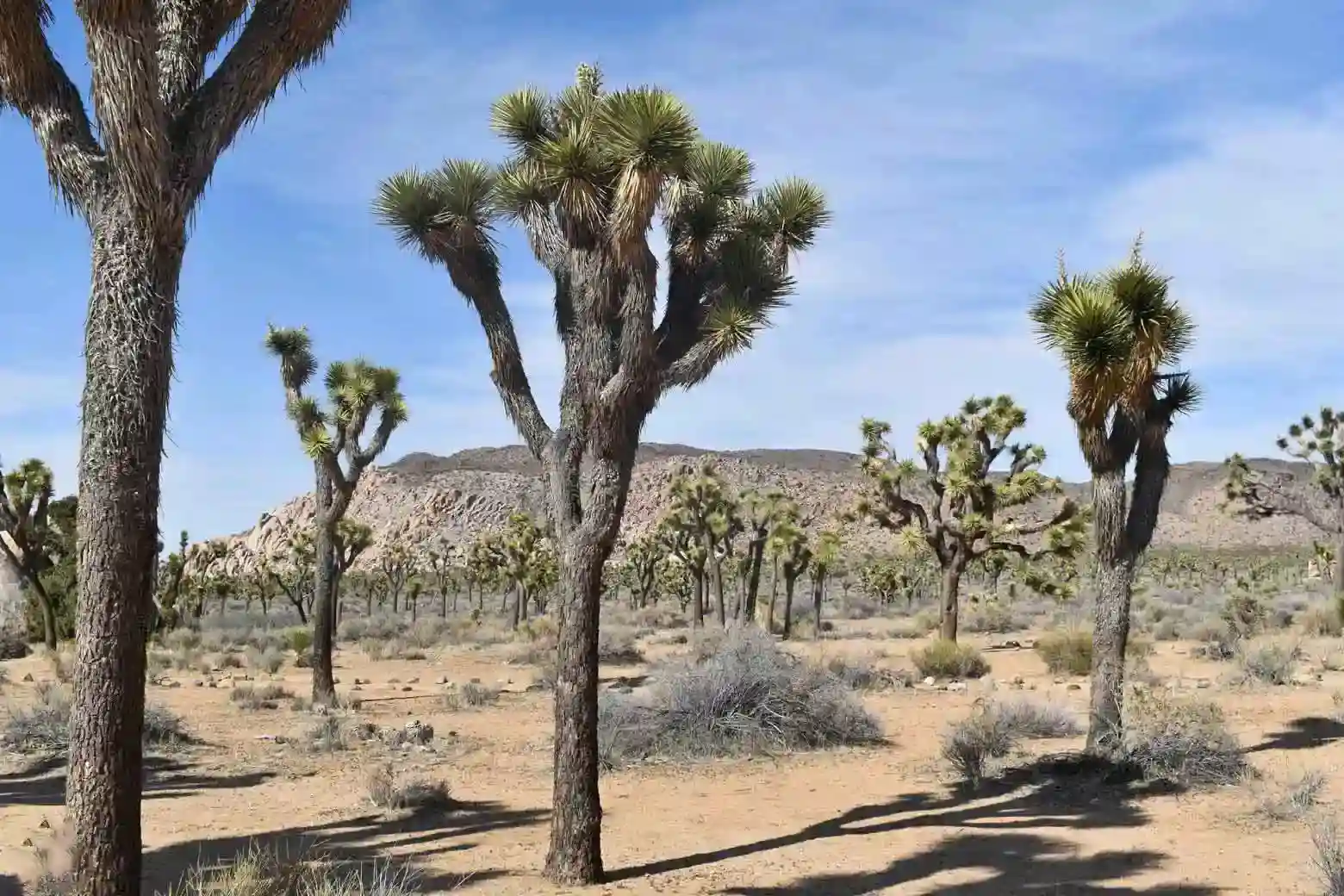
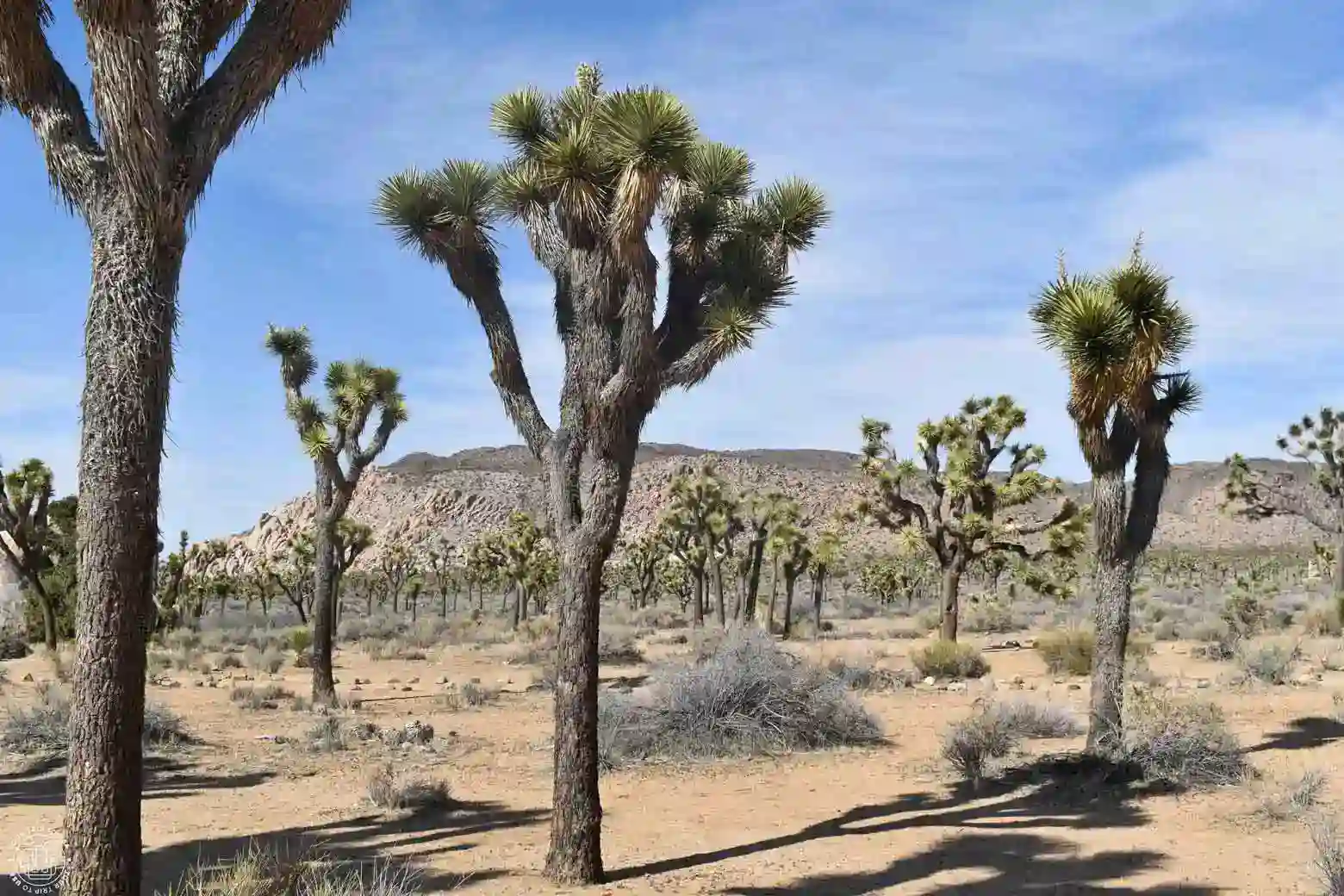
The main attractions of Joshua Tree are located in the northern part of the park along Park Boulevard, the main road that begins at the West Entrance (main access from Los Angeles) and ends at the North Entrance, allowing you to make a loop to enter through one of the entrances and exit through the other.
💡Recommended: How to visit Joshua Tree | Guide + Tips + Map |
It's also possible to take Pinto Basin Road, a road that starts at Park Boulevard and heads south of the park, where there are fewer attractions (but some that are equally interesting).
Here's everything to see and do in Joshua Tree, focusing on the most interesting parts of the park. At the end of the article, you'll find a map with all the locations marked!
1. Hidden Valley
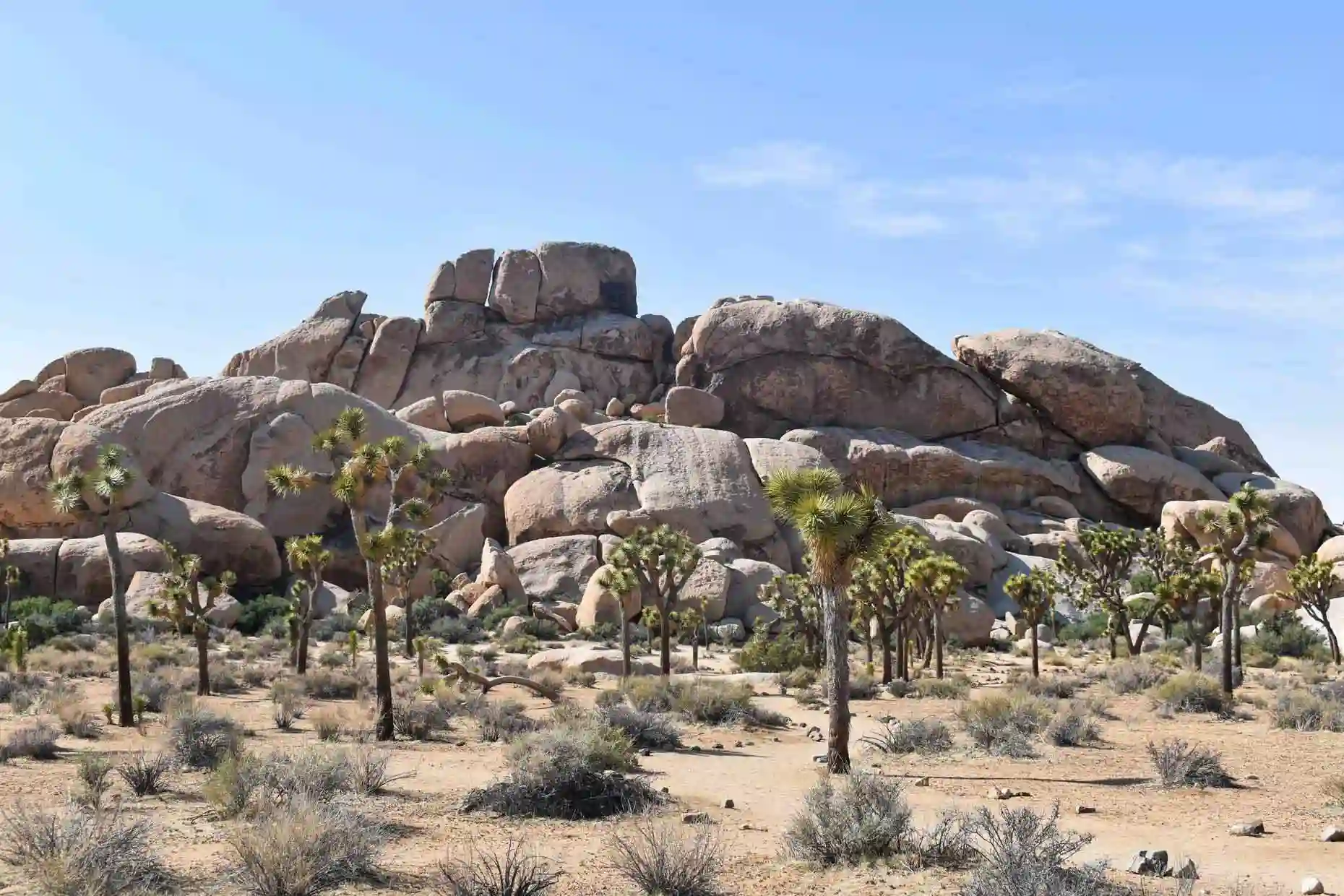
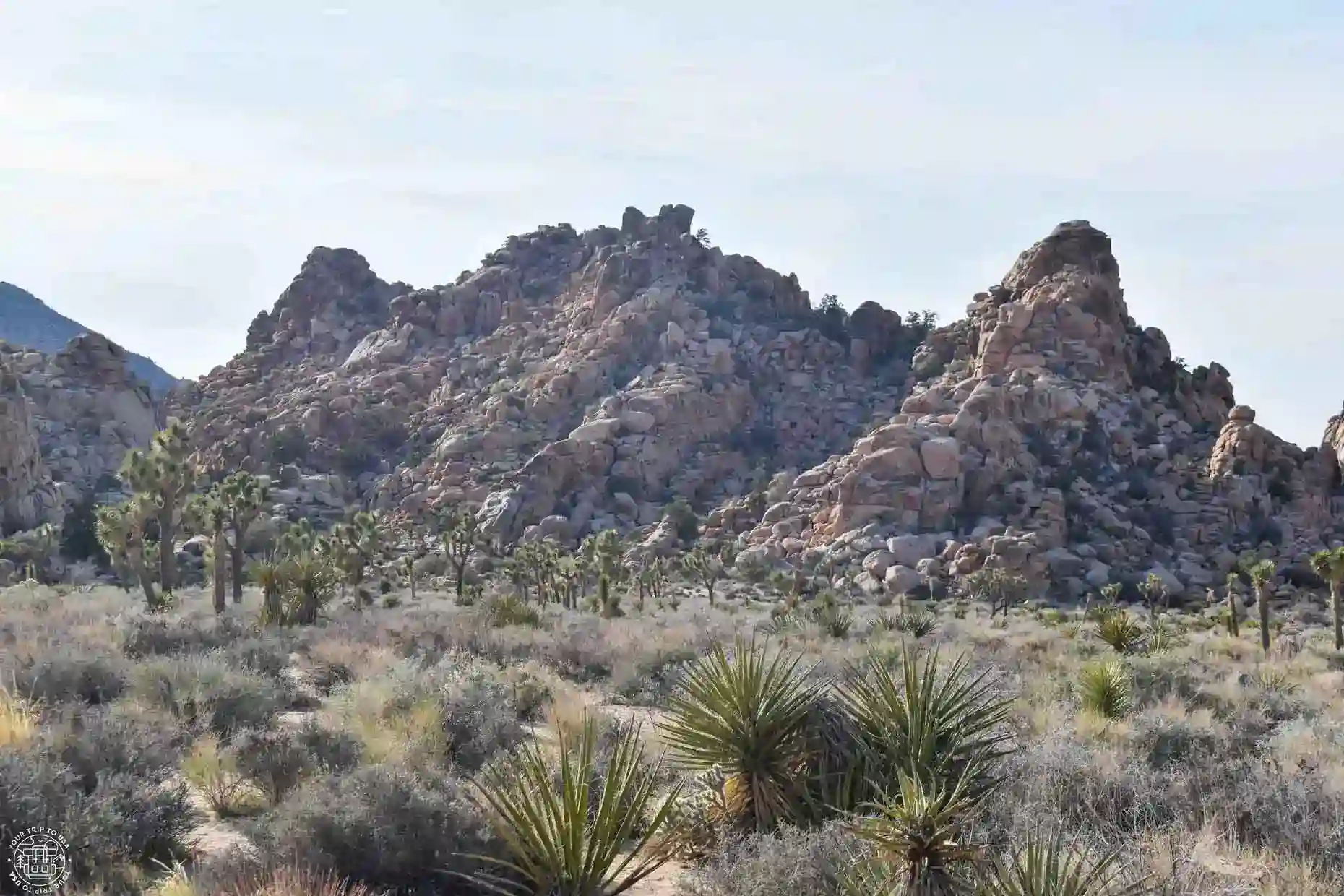
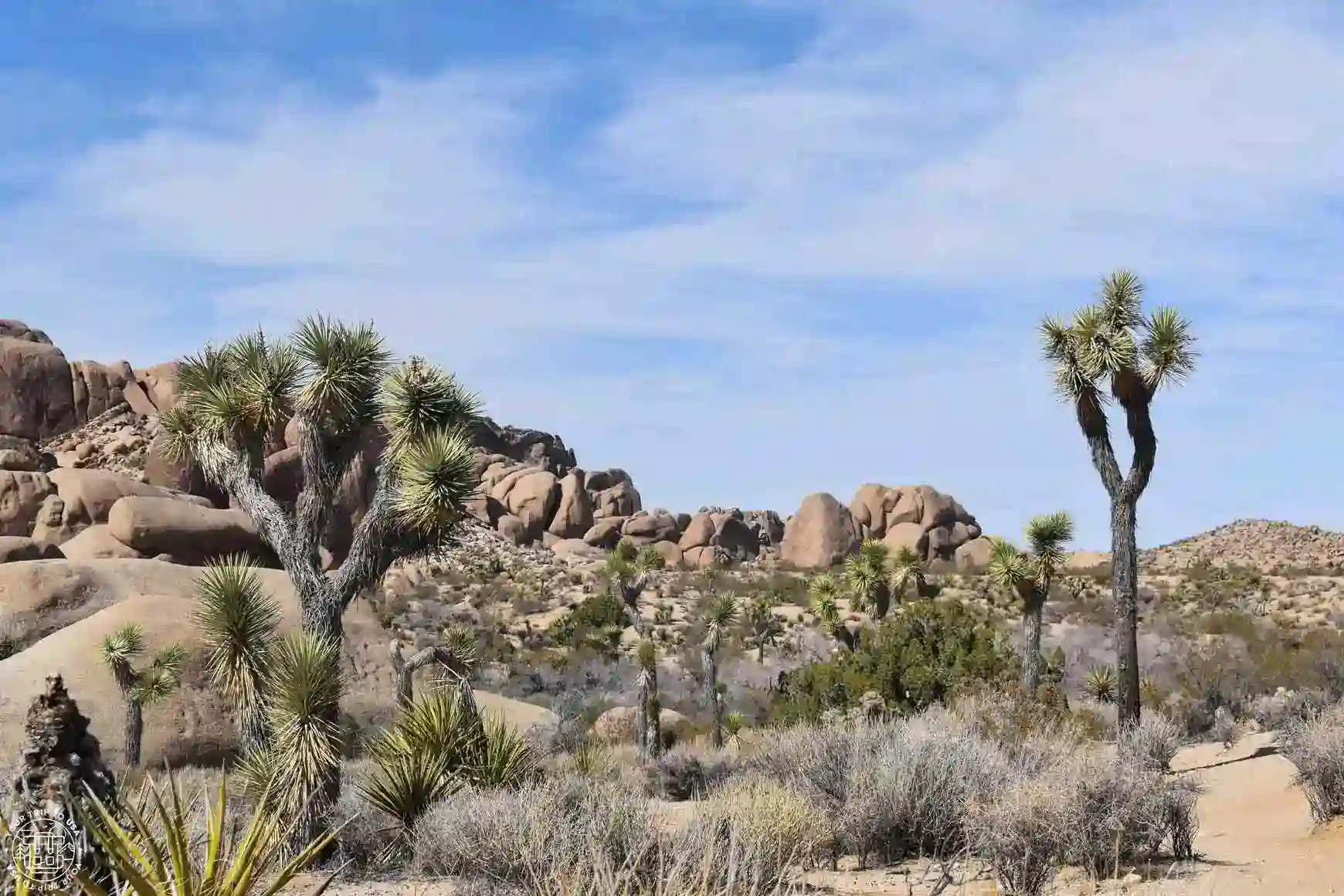
If you enter Joshua Tree through the West Entrance, you'll have full access to Park Boulevard, a beautiful road surrounded by the famous yucca trees that characterize the park. The first stop we recommend is Hidden Valley. From the parking lot, a 1.6 km (1-mile) loop awaits you, taking you into a scenic valley full of rock formations, some of which are very large.
It's an easy hike, but there are some sections with steps and others where you have to walk over rocks.
2. Keys Desert Queen Ranch
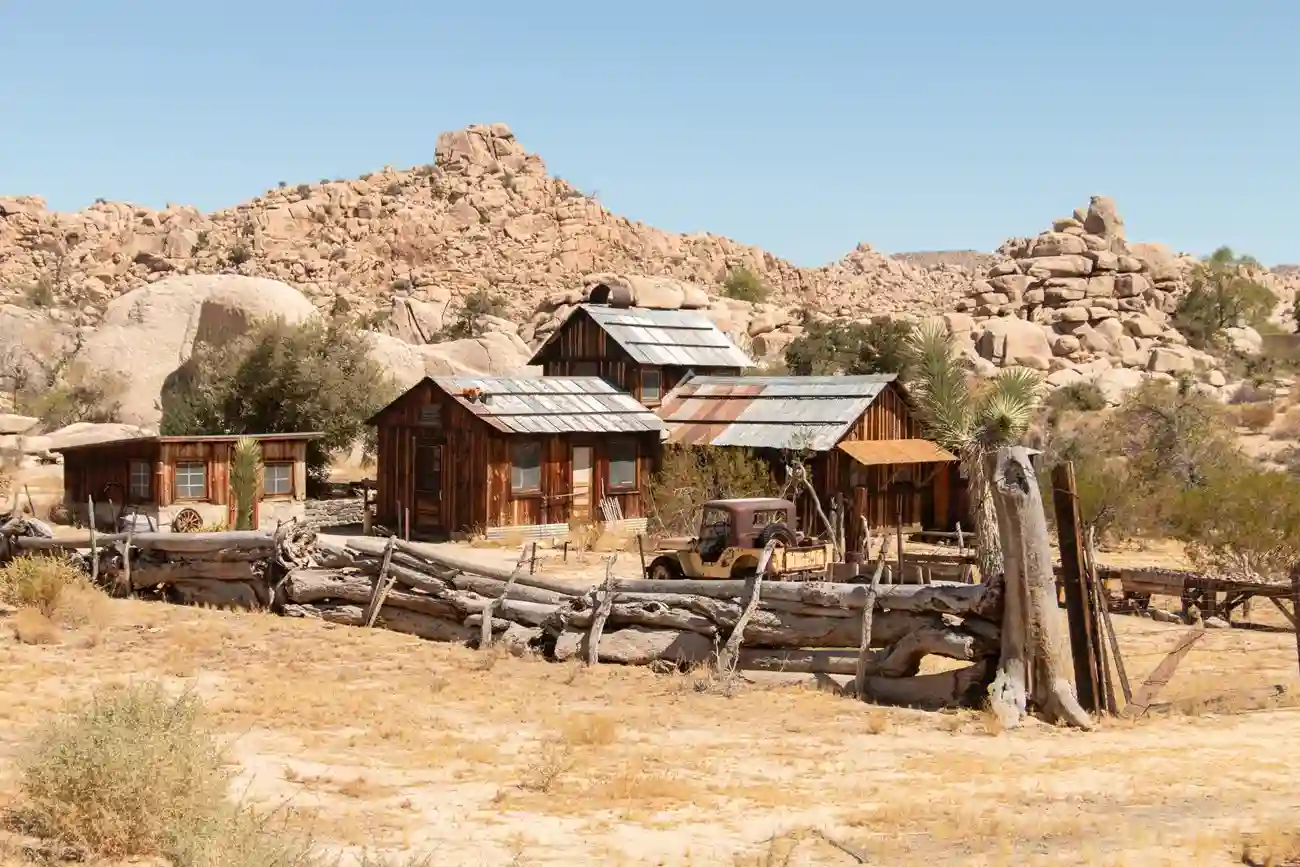
A short distance from Hidden Valley, there is a secondary road (Barker Dam Road) that takes you to some interesting places. One of them is the Keys Desert Queen Ranch, a farm of great historical importance in the park that can only be visited on a guided tour led by a ranger, who will teach you about the family that ran it, mining, agriculture, Native Americans, and what happened to this ranch.
ℹ️ Tours last 120 minutes, run twice daily from October to May (9:30 a.m. and 1:00 p.m.), and tickets must be purchased in advance through recreation.gov up to 60 days before the date. The cost is $20 for adults and $10 for children ages 4 to 11.
3. Barker Dam Nature Trail
If you continue along Baker Dam Road, you'll reach a parking lot. From here starts one of the easiest treks in Joshua Tree starts, ideal for families!
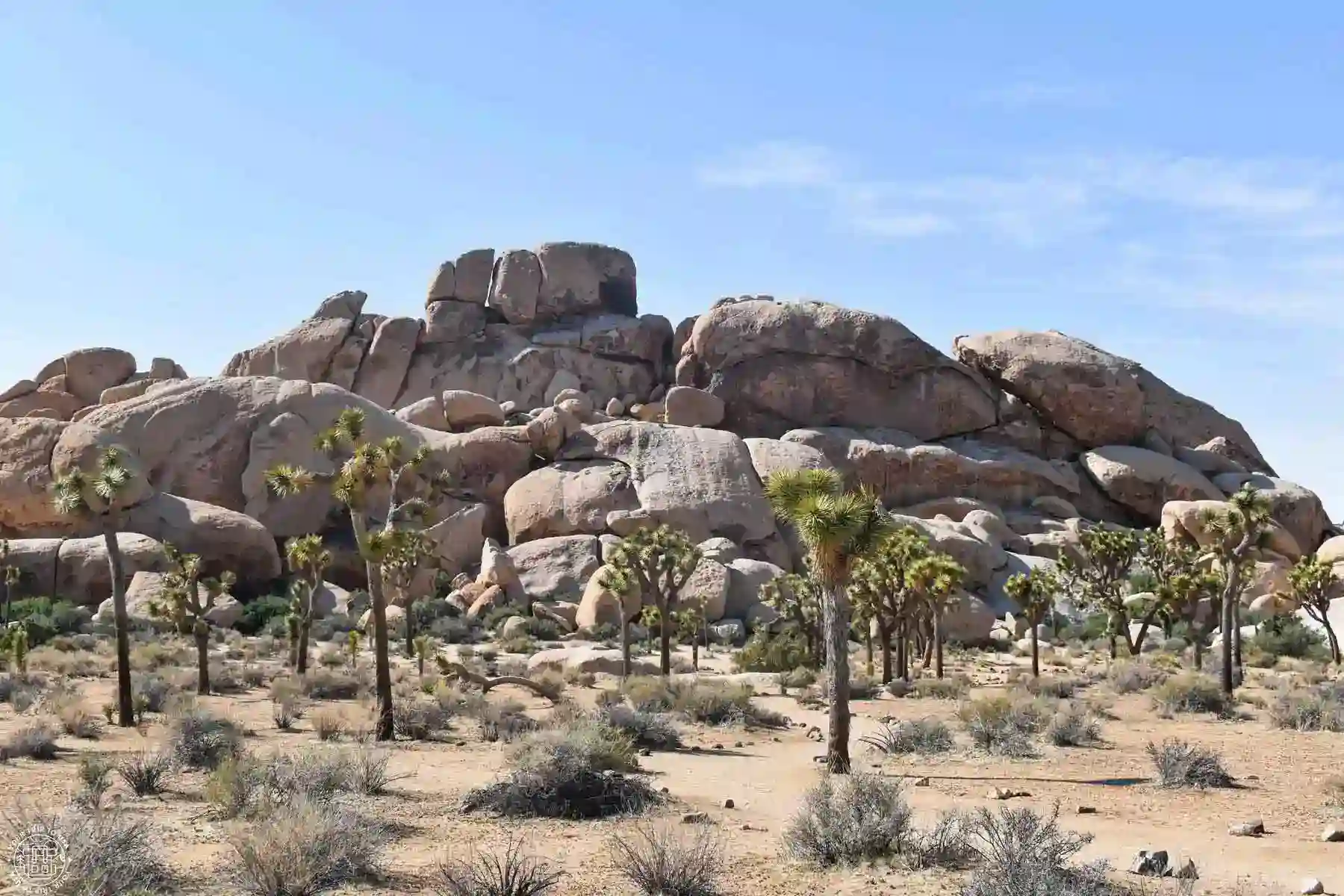
Barker Dam Nature Trail is a 1.8 km (1.1 mi) loop that will introduce you to native wildlife, the granite rock formations so typical of the park, Joshua trees, and Barker Dam, a dam built by the first occupants to store water. Don't get your hopes up about finding it full of water, as that only happens on the rare occasions when it rains in the park.
4. Wall Street Mill Trail
The Wall Street Mill Trail, a 3.2 km (2 mi) round trip hike, is perfect for children. It starts from the same parking lot as the previous one. The final destination is the remains of an old mill that was used to process gold, as several mines were established in the area by those looking to get rich. Along the way, you'll come across several rusty old cars, which create a very cool contrast in the middle of the desert.

DO YOU NEED A RENTAL CAR IN THE UNITED STATES?
Take a look at this search tool and get the best price!
5. Cap Rock
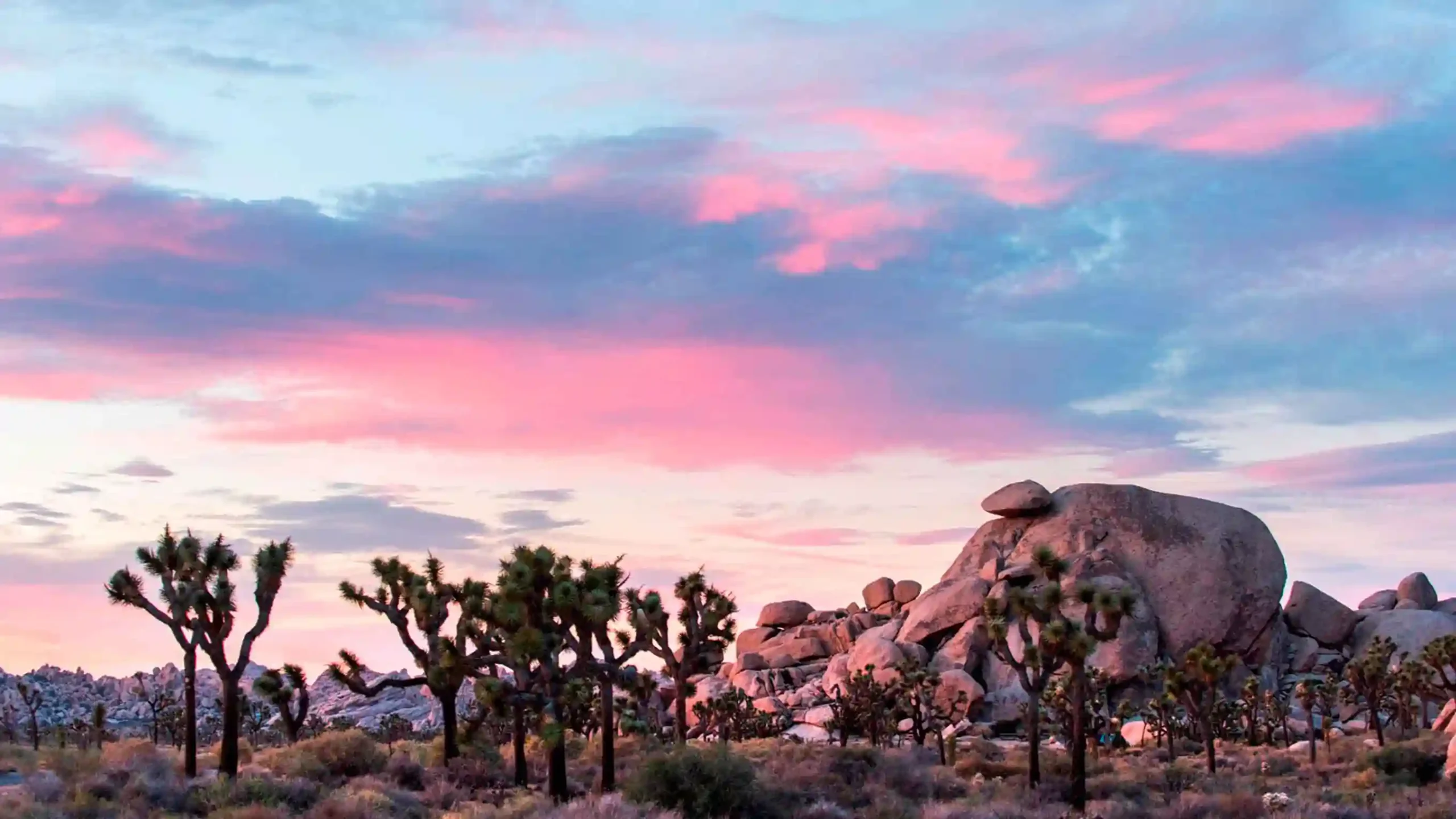
At the intersection of Park Boulevard and Keys View Road, you can stop to photograph one of the most massive rock formations in the national park. This is Cap Rock, so named because it has a smaller rock on top, making it look like it's wearing a cap. You can get close to it by taking a very easy loop of less than 1 km (0.6 mi).
6. Keys View
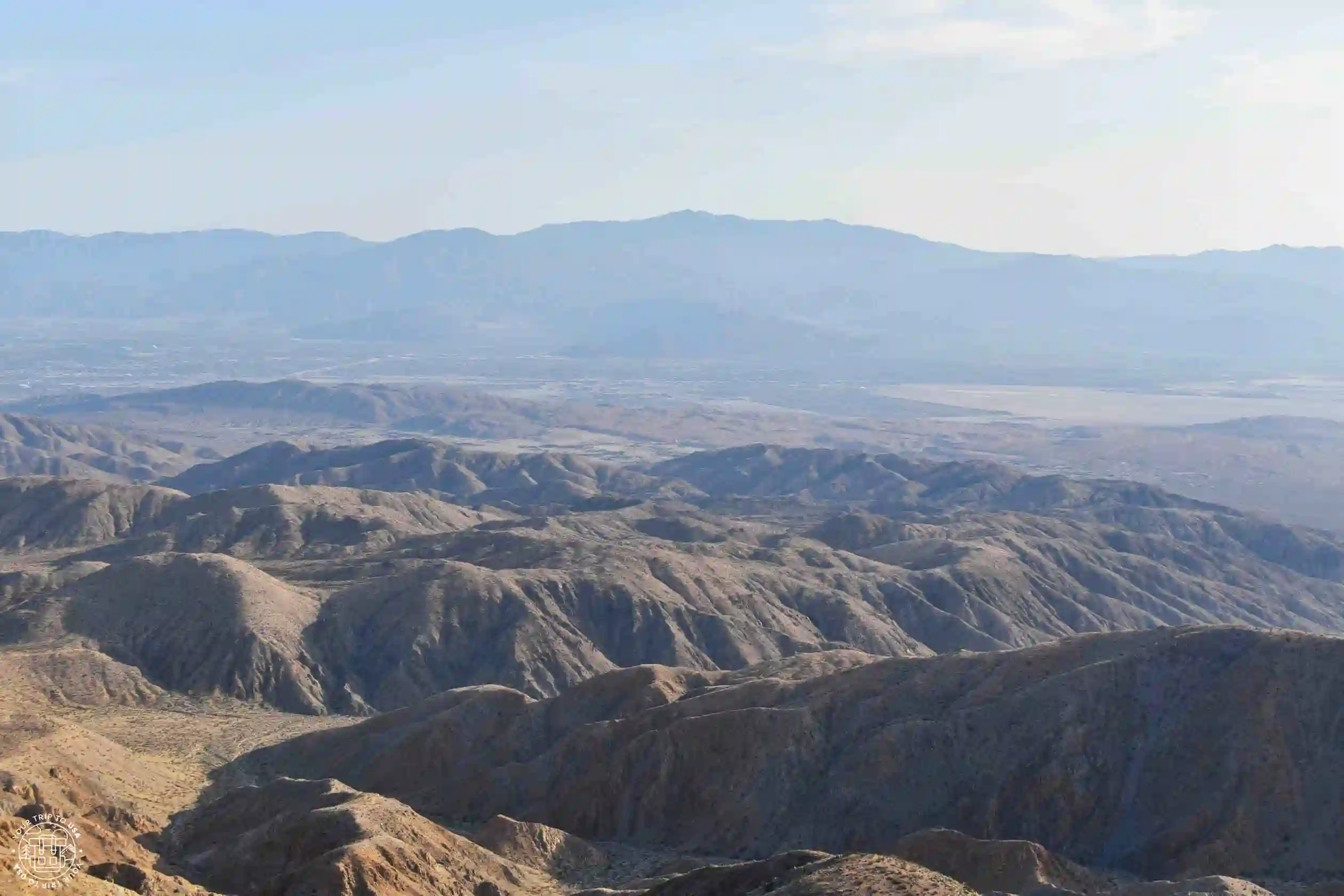
Welcome to the most famous viewpoint in Joshua Tree National Park! Keys View is located at the end of Keys View Road, a beautiful road lined with the famous yucca trees.
This viewpoint is very popular for watching the sunrise and/or sunset, as it's located at an altitude of 1,581 meters (5,185 ft) and offers spectacular panoramic views of the southern side of the park, the San Bernardino Mountains, and the Coachella Valley. On clear days, you can see the Salton Sea and even Signal Mountain, a mountain that belongs to Mexico and is 145 km (90 mi) away.
7. Hall of Horrors
Are you passionate about slot canyons? Those narrow gorges formed by erosion that are so popular on the West Coast of the U.S., such as the famous Antelope Canyon. Well, in Joshua Tree you can find a couple of these canyons, allowing you to have fun while trying to squeeze through narrow crevices and not get stuck.
💡Recommended: Where to stay in Joshua Tree | Areas + Hotels + Map |
The Hall of Horrors loop is short and easy, although you have to pay close attention to find the entrance to the slot canyons. If you follow the route clockwise (recommended), you'll find them in the second set of rocks you come across on the way, on the far right. Here you'll see that there are two entrances: the one on the far right leads to a wider canyon, and the one on the far left is narrower and more difficult to access.
8. Skull Rock
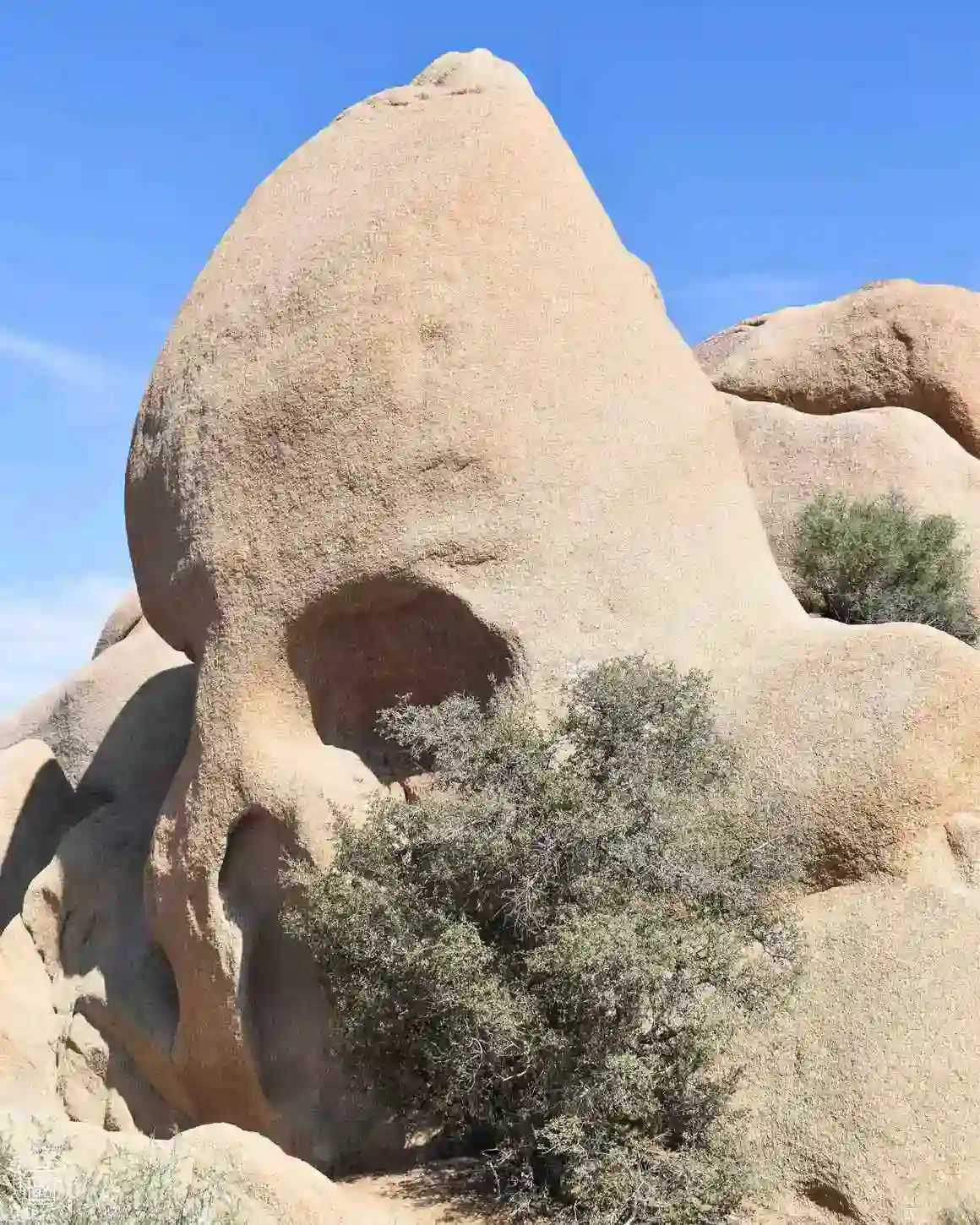
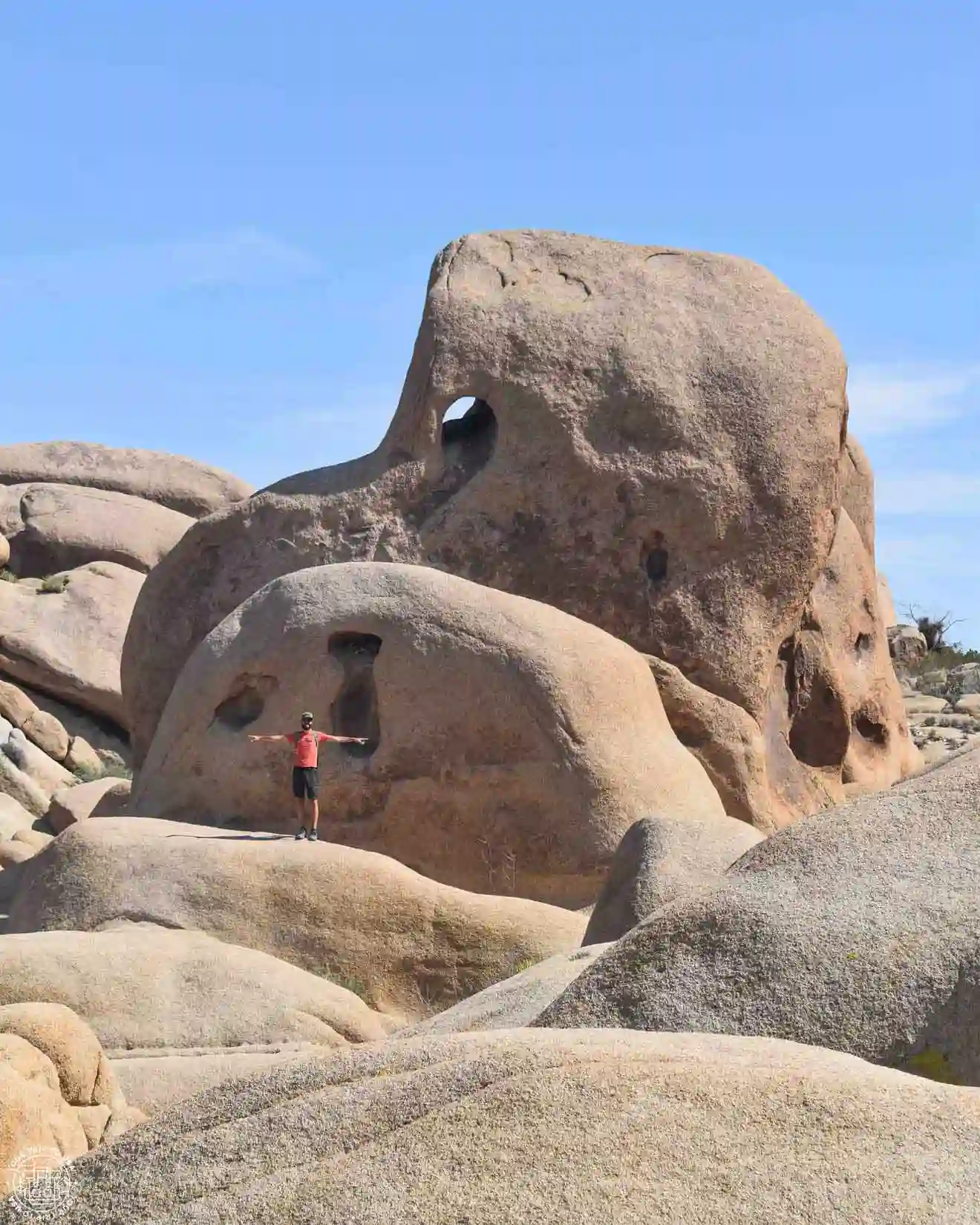
If there is one rock that attracts all the attention in the park, it's Skull Rock. This skull-shaped formation is very curious, making all visitors want to take pictures with it. It's incredible how rainwater has sculpted it, creating hollowed-out cavities that resemble a skull.
It's one of the most popular places in Joshua Tree due to its easy access, which means that it's usually impossible to find a space in the designated parking area and you have to resort to leaving your car on the side of the road.
If you want to extend your visit, from here you can take the Skull Rock Nature Trail (which connects to the Jumbo Rocks Campground) or the Discovery Trail, a short loop that connects to other trails such as the Face Rock Trail and the Split Rock Trail. The latter takes you to see a huge rock split into two parts.
9. Arch Rock & Heart Rock
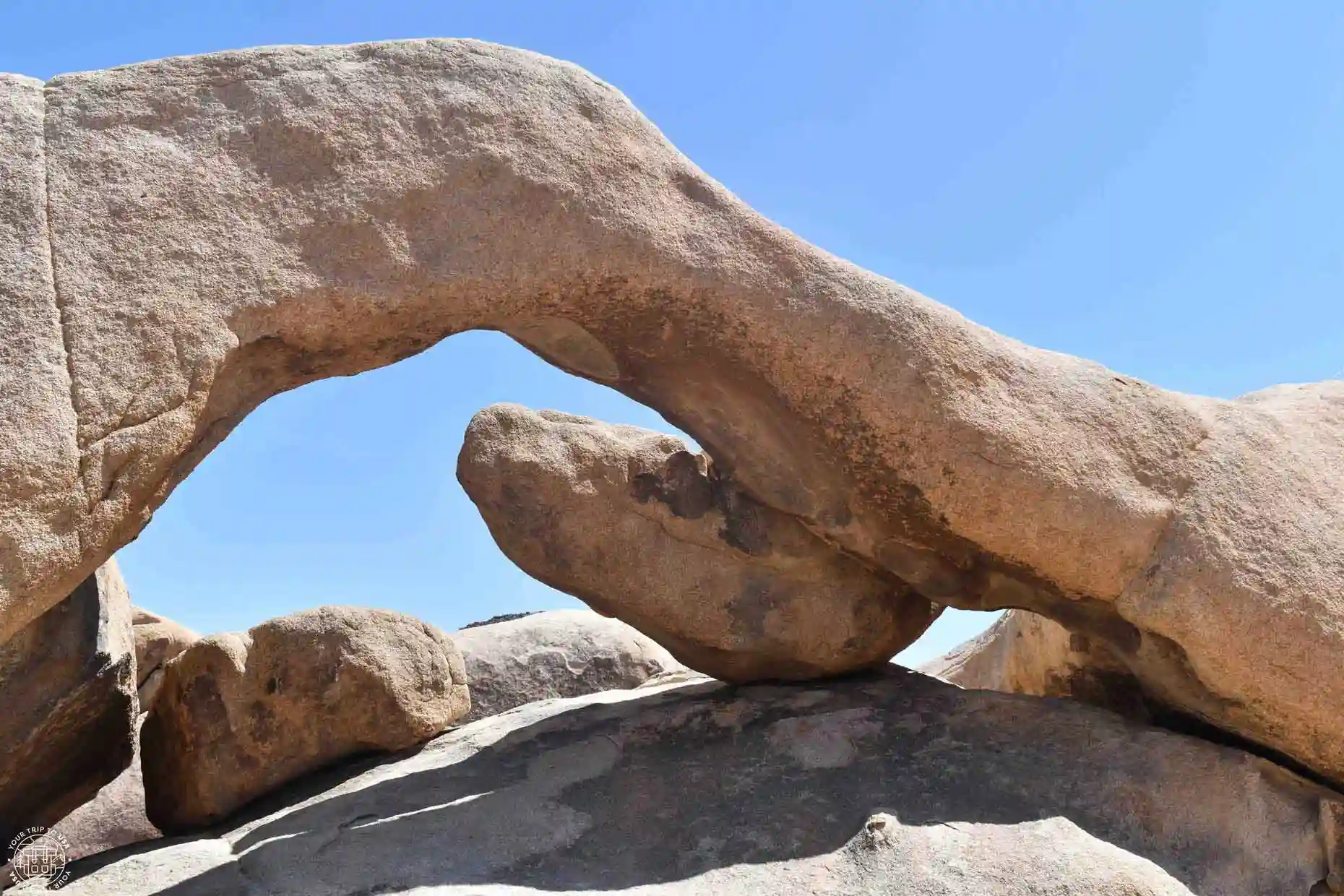
Continuing with Joshua Tree attractions, you can't miss the Arch Rock and the Heart Rock. In this case they're located on Pinto Basin Road, the road that goes to the south of the park. You must leave your vehicle in the Twin Tanks parking lot (not on the side of the road, as we saw rangers fining those who were parked there). From here, there is a very easy and short lollipop loop that takes you to the famous Arch Rock in Joshua Tree.
This natural arch is one of the must-see places to visit in Joshua Tree, and we're sure you'll want to take a souvenir picture there. To do so, you'll have to climb the rock, as it's located a little high up.
To complete the walk, go in search of Heart Rock, located about a quarter mile ahead (400 meters). This heart-shaped rock was unknown until recently, but we can assure you that it's no longer. When we arrived, there was a line to take a picture with it! The good thing is that there is always someone willing to take photos for you. 😊
10. Cholla Cactus Garden
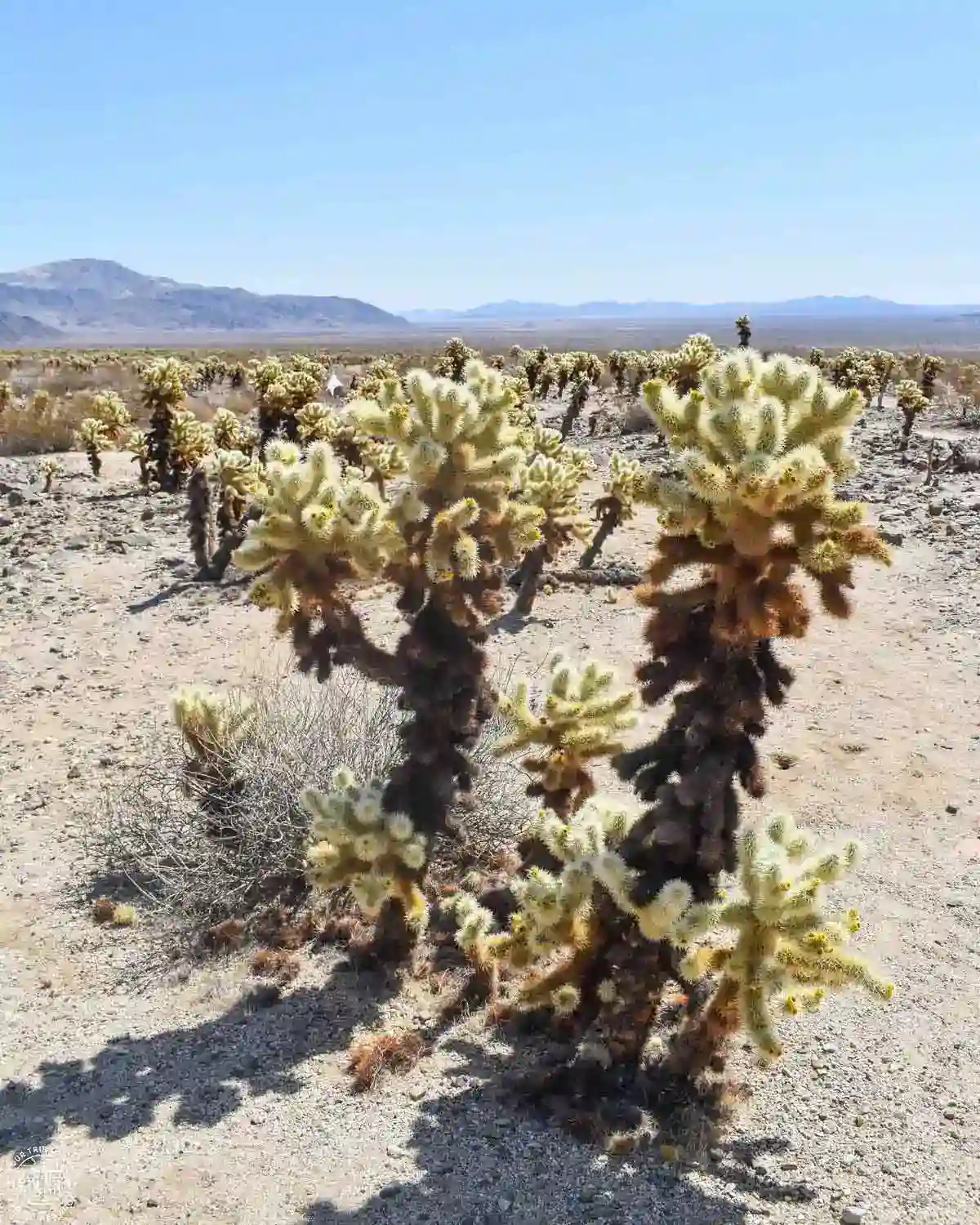
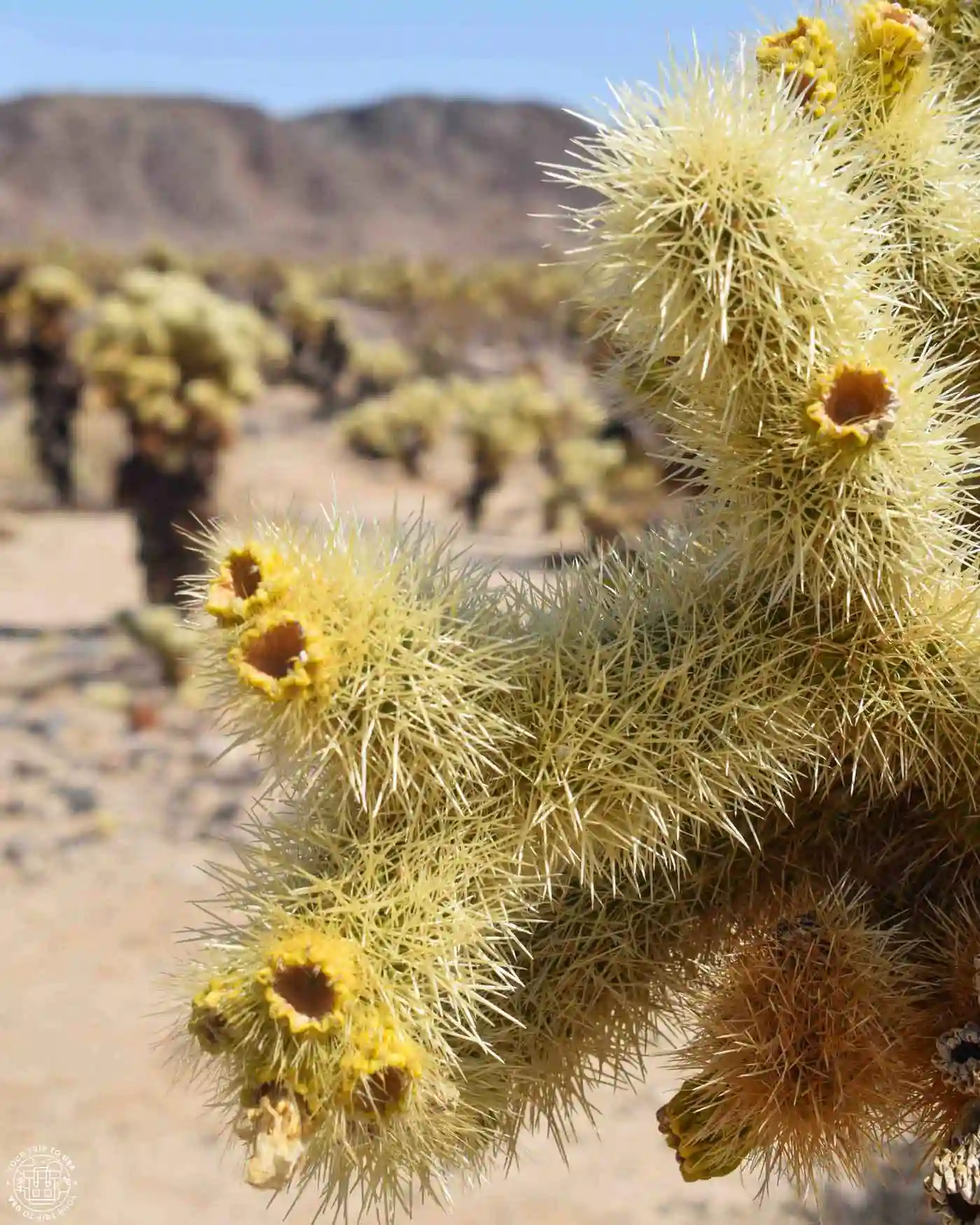
Heading south on Pinto Basin Road, you absolutely must stop at the Cholla Cactus Garden. It's one of our favorite places in Joshua Tree—we think it's super photogenic and unique!
🌵 This garden full of teddybear cholla is located at the transition between the Mojave and Colorado deserts, an ideal spot for their reproduction. To do this, the tips of the stems fall to the ground, where they accumulate because the wind is unable to blow them away. Here they take root and give rise to a new plant.
🩹 This is important to know because, without realizing it, you can step on these spikes while walking, which can get stuck in your shoes and be very painful. We speak from experience! Our recommendation: wear closed-toe shoes if you don't want to end up with feet like a sieve.
11. Ocotillo Patch
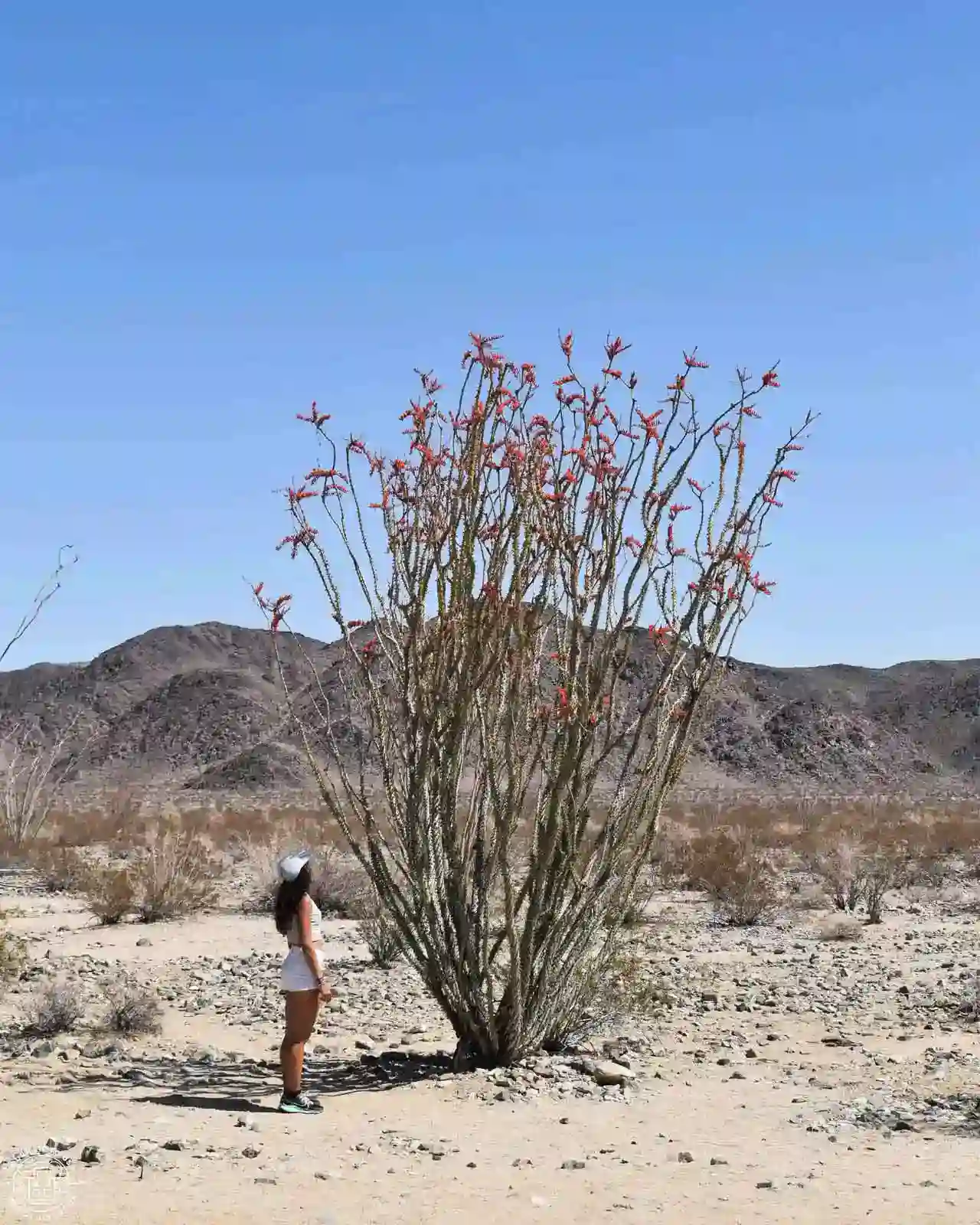
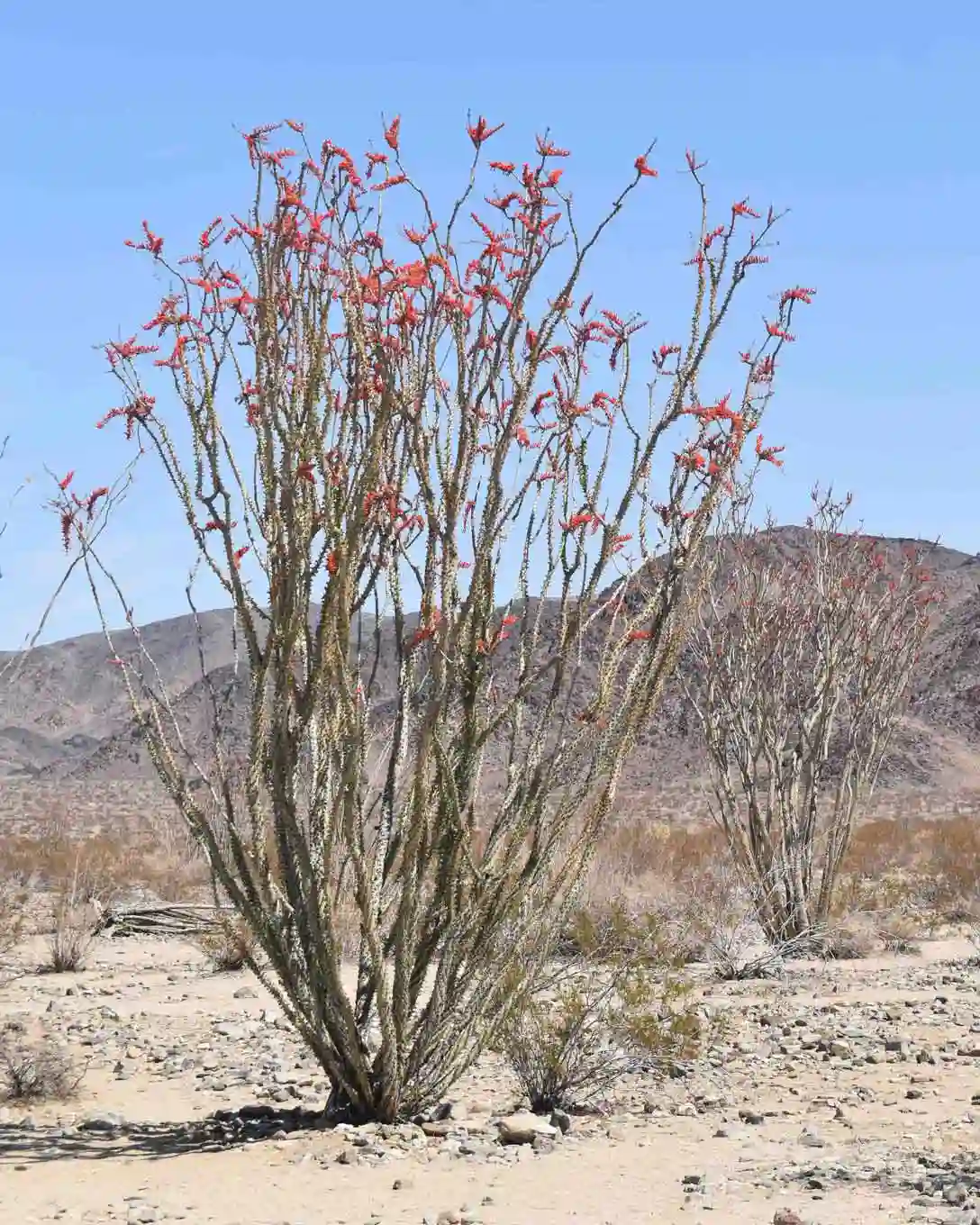
The last stop we recommend in the southern part of the park is Ocotillo Patch, an area where more humidity accumulates and where more plants grow. The most striking is the Ocotillo, a large cactus-like shrub native to the deserts of the southwestern United States and northern Mexico, used in traditional medicine for centuries.
🌹 Ocotillo can bloom up to five times a year, as the flowering of this plant doesn't depend on the season, but on the amount of rainfall in the area. When it rains, the tips of its branches burst with red flowers, creating a beautiful visual contrast. That's how we found them!
12. Black Rock Canyon Area
Located at the northwest tip of the park is the Black Rock Canyon area, which is accessed from the town of Yucca Valley. Fewer people visit this area because, in addition to being more remote, it isn't connected by road to the rest of the national park.
There is a small visitor center and a campground here, and it's an ideal area for hiking enthusiasts, as some of the best hikes in Joshua Tree can be found here. They are more scenic and demanding, as they gain more elevation, offering views of the mountains surrounding the park. Some examples are the Hi-View Nature Trail, Eureka Peak, and Panorama Loop.

e-sim for THE UNITED STATES
We have 2 discounts for you:
-5% OFF with Holafly ➡️ Unlimited data with the best coverage! Get it here
-30% OFF with eSIMFlag ➡️ Unlimited data at the best price! Get it here
Discounts applied automatically
🤓 Take a loot at: Best SIMs & eSIMs for traveling to the USA
13. Sky's the Limit Observatory
Stargazing is one of the best things to do in Joshua Tree! Joshua Tree is a Dark Sky Park due to its elevation, low light pollution, and location in the middle of the desert. At night it's a spectacular sight, and at Sky's the Limit you can join educational programs on astronomy, visit its observatory and planetarium, and even meditate in its garden. Admission is free, and you can enter as long as there are no events taking place.
Although it's actually outside the park, this place is located next to the North Entrance and very close to Twentynine Palms.
If you're staying near Joshua Tree, don't forget to go out at night. The park is open 24 hours a day and is one of the best places in the US to see stars and the Milky Way. Another option is to book this stargazing tour in Joshua Tree, an expert astronomer will accompany you for the most magical night of your life.
14. Oasis of Mara
Next to Twentynine Palms and to the park headquarters, you can take a very short and easy 0.8 km (0,5 mi) trail, the Oasis of Mara. In this oasis, you can see the California fan palm, as well as other plant species found in few places, such as arrow-weed and Mojave seablite.
Best hikes in Joshua Tree National Park
Although we've already told you about some hikes in Joshua Tree, we haven't mentioned them all. If you're looking to go hiking here, here's a summary of the best trails in the park.
| BEST HIKES IN JOSHUA TREE NATIONAL PARK | ||||
|---|---|---|---|---|
| Difficulty | Distance | Estimated time | Area | |
| Hidden Valley | 🟢 | 1.6 km (1 mi) loop | 30 min | Park Boulevard |
| Barker Dam | 🟢 | 1.8 km (1.1 mi) loop | 35 min | Barker Dam Road |
| Wall Street Mill | 🟢 | 3.2 km (2 mi) round trip | 1 hr - 1 hr 20 min | Barker Dam Road |
| Hall of Horrors | 🟢 | 1.5 km (0.9 mi) loop | 45 min if you enter the slot canyons | Park Boulevard |
| Skull Rock Nature Trail | 🟢 | 2.8 km (1.8 mi) loop | 1 hr | Park Boulevard |
| Discovery Nature Trail | 🟢 | 1.1 km (0,7 mi) loop | 25 min | Park Boulevard |
| Split Rock Trail | 🟢 | 4 km (2.5 mi) loop | 1 hr 30 min | Park Boulevard |
| Oasis of Mara | 🟢 | 0.8 km (0.5 mi) loop | 15 min | North Entrance |
| Cap Rock Nature Trail | 🟢 | 0.6 km (0.4 mi) loop | 15 min | Park Boulevard |
| Lost Horse Mine | 🟡 | 6.5 km (4 mi) loop | 2 hrs | Keys View Road |
| Ryan Mountain | 🔴 | 4.5 km (2.8 mi) round trip | 2 hrs - 2 hrs 30 min | Park Boulevard |
| Arch & Heart Rock | 🟢 | 2.8 km (1.7 mi) lollipop | 1 hr | Pinto Basin Road |
| 49 Palm Oasis | 🟡 | 4.8 km (3 mi) round trip | 2 hrs | Canyon Road |
| Hi-View Trail | 🟢 | 2.2 km (1.4 mi) loop | 30 - 45 min | Black Rock Canyon |
| West Side Loop | 🟡 | 7.5 km (4.7 mi) loop | 3 hrs 30 min | Black Rock Canyon |
| Panorama Loop Trail | 🔴 | 10.6 km (6.6 mi) loop | 4 hrs - 5 hrs | Black Rock Canyon |
| Eureka Peak | 🔴 | 17.7 km (11 mi) round trip | 5 hrs- 5 hrs 30 min | Black Rock Canyon |
| 🟢 easy, 🟡 moderate, 🔴 difficult | ||||
What to do in Joshua Tree in half a day (4-5 hours)
Although half a day is not much time to explore Joshua Tree National Park, sometimes you can only spend a few hours, either because you're passing through or because your visit is in the middle of summer.
Considering that you're coming from Los Angeles, we'd enter through the West Entrance and exit through the North Entrance, making a loop that follows Park Boulevard and taking a few detours. It's also possible to do it the other way around without any problems, for example if you're coming from Las Vegas (you would just have to change the order of the visits).
- Joshua Tree Visitor Center. Stop here to learn about the park and pay your entrance fee if you don't have an annual pass.
- Hidden Valley (🚗30 min +🚶🏼30 min)
- Cap Rock (🚗5 min + 🚶🏼10 min)
- Keys View (🚗10 min + 🚶🏼20 min)
- Skull Rock (🚗20 min + 🚶🏼20 min)
- Arch Rock & Heart Rock (🚗10 min +🚶🏼45 min)
- Cholla Cactus Garden (🚗15 min + 🚶🏼20 min)
- Exit through North Entrance (🚗25 min)
 DO YOU NEED A NO FEES CARD FOR YOUR TRIPS?
Get your Wise card here for free
Withdraw money and pay in other currencies without fees!
💳Check it out: Best Travel Cards for the USA | Comparison & Opinion |
What to do in Joshua Tree in 1 day
If you have a full day to explore Joshua Tree, in addition to all of the above, you can go on a few more hikes in the park, visit some extra spots, and admire the stars at night. That's what we'd do, considering that your visit isn't in the summer and that you're coming from Los Angeles (if not you'll have to change the order of the stops):
- Joshua Tree Visitor Center. Stop here to learn about the park and pay your entrance fee if you don't have an annual pass.
- Hidden Valley (🚗30 min +🚶🏼30 min)
- Barker Dam (🚗5 min +🚶🏼35 min)
- Wall Street Mill (🚶🏼60 min)
- Cap Rock (🚗10 min + 🚶🏼10 min)
- Keys View (🚗10 min + 🚶🏼20 min)
- Skull Rock (🚗20 min + 🚶🏼20 min)
- Arch Rock & Heart Rock (🚗10 min +🚶🏼45 min)
- Cholla Cactus Garden (🚗15 min + 🚶🏼20 min)
- Ocotillo Patch (🚗5 min + 🚶🏼15 min)
- Sky's the Limit (🚗30 min +🚶🏼30-45 min)
- Oasis of Mara (🚗5 min + 🚶🏼20 min)
- Stargazing at night. We recommend staying near Joshua Tree so you are just a few minutes' drive from the park or booking this stargazing tour in Joshua Tree.
What to do in Joshua Tree in 2 days
If you have two full days to visit Joshua Tree, you'll be able to take your time and see both the must-see sights and other less-visited parts of the park. Considering that your visit isn't in summer and that you're coming from Los Angeles, we would do the following:
Day 1 in Joshua Tree
- Joshua Tree Visitor Center. Stop here to learn about the park and pay your entrance fee if you don't have an annual pass.
- Hidden Valley (🚗30 min +🚶🏼30 min)
- Keys Ranch guided tour (🚗5 min +🚶🏼120 min). Remember that you have to book it through recreation.gov and that it only runs from October to May. Choose the 9:30 a.m. tour.
- Barker Dam (🚗5 min +🚶🏼35 min)
- Wall Street Mill (🚶🏼60 min)
- Cap Rock (🚗10 min + 🚶🏼10 min)
- Keys View (🚗10 min + 🚶🏼20 min)
- Hall of Horrors (🚗15 min + 🚶🏼45 min)
- Skull Rock (🚗10 min + 🚶🏼20 min)
- Stargazing at night. We recommend staying near Joshua Tree so you are just a few minutes' drive from the park or booking this stargazing tour in Joshua Tree.
Day 2 in Joshua Tree
- Sky's the Limit (🚶🏼30-45 min)
- Arch Rock & Heart Rock (🚗15 min +🚶🏼45 min)
- Cholla Cactus Garden (🚗15 min + 🚶🏼20 min)
- Ocotillo Patch (🚗5 min + 🚶🏼15 min)
- Keys View (🚗45 min +🚶🏼30-45 min)
- Black Rock Canyon area if you have time (🚗45 min +🚶🏼60 min or more)
What to do around Joshua Tree
Did you know that there are many other places to see near Joshua Tree? We're sure you'll pass by some of them on your way to or from the park, so it might be a good idea to visit the ones that catch your eye. Here's a list of our favorites:
1. The End of the World sign
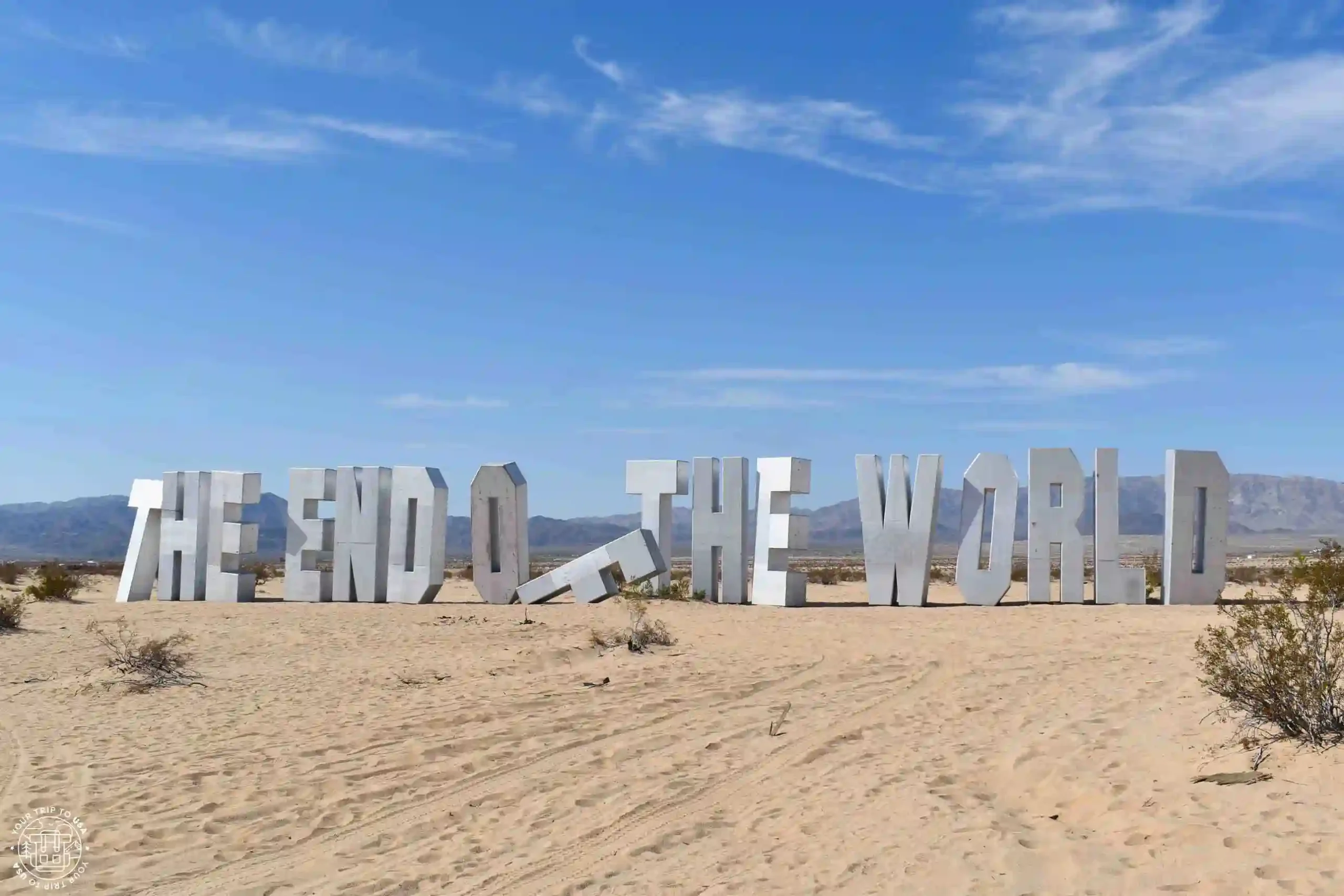
Located 22 km (14 mi) from Twentynine Palms, you can take a picture with giant silver letters in the middle of the Mojave Desert that spell out "The End of the World". They remind to Hollywood sign in Los Angeles! They were created in 2022 by artist Jack Pierson, who reuses abandoned signs to make his art.
When we visited, all the letters were still standing except for the F. However, now more letters have fallen down, and some have even broken. Even so, it's an interesting place to stop by if you're in the area!
2. The Giant Rock
If you haven't had enough of rocks during your visit to the national park, there's a big one waiting for you 32 km (20 mi) from the town of Joshua Tree and 10 km (6 mi) from Landers. It's said to be as tall as a 7-story building! And the most curious thing is that a portion of it broke off in 2020, so that "little" piece still remains next to it.
😫 What we dislike about this place is that the rock is covered in graffiti and tagging, which reflects some people's lack of respect for nature and for the native cultures, who considered it sacred.
ℹ️ The access road is unpaved and there're sections where there can be quite a lot of sand, so we only recommend venturing there if you have a 4x4 vehicle or one with good clearance.
3. Pioneertown
Pioneertown is a curious town set in the Wild West, located 10 minutes drive from Yucca Valley. Here you can find saloons, stables, and old houses with wooden facades, but the most curious thing is that it was actually created as a giant movie set.
Its construction dates back to 1946, when a group of Hollywood investors (including actor Roy Rogers) wanted to create a place to shoot Western movies and TV series. Something different from other movie sets is that Pioneertown was not only used for filming, but all those facades housed real businesses that came to life when filming ended.
In addition to strolling among its historic buildings, visit the famous Pappy & Harriet's cantina, one of the most iconic bars in the desert. And if you want to make your visit complete, stay at the Pioneertown Motel, an accommodation that retains that retro feel without compromising on quality.
4. Roy's Motel and Cafe
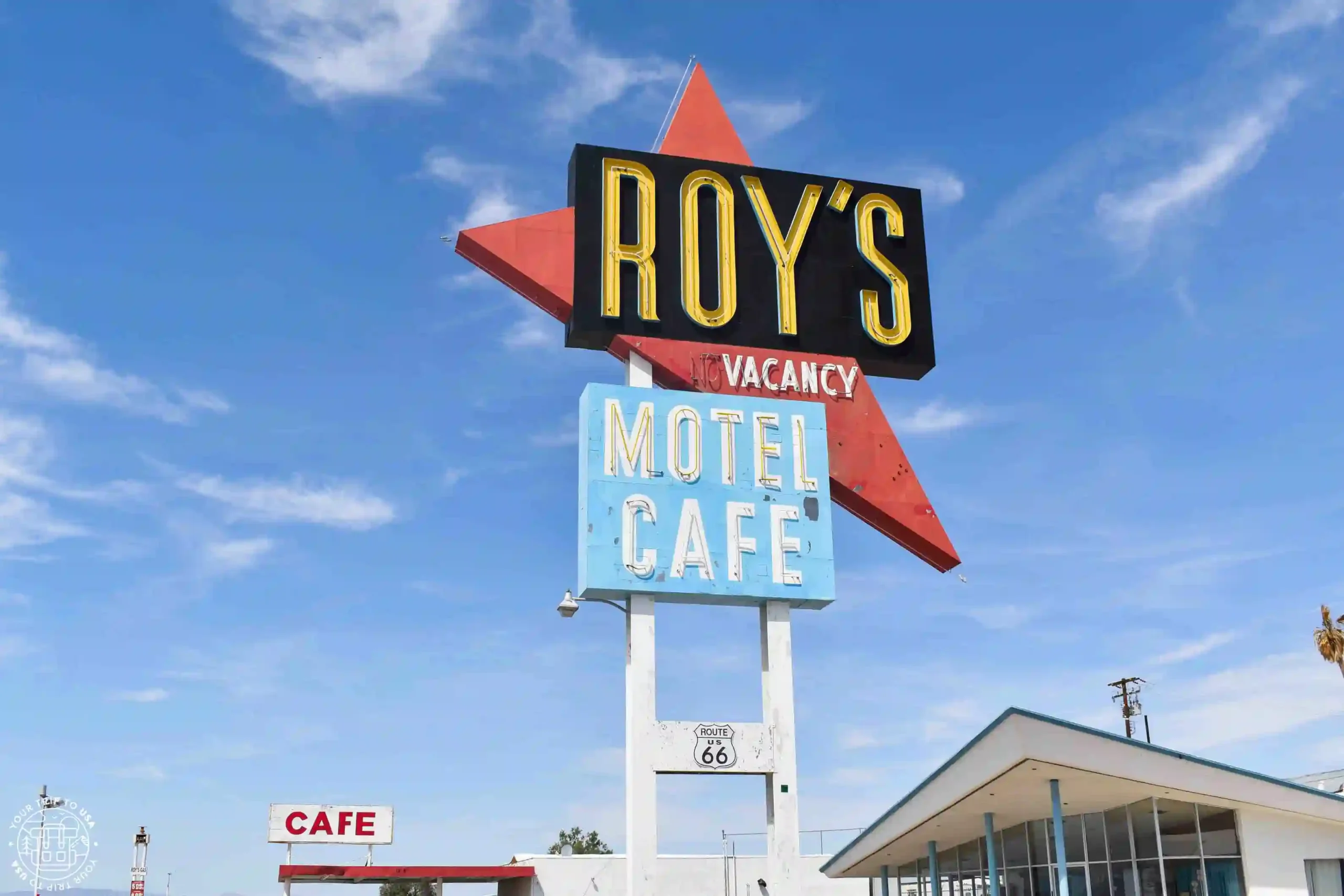
Further away from the national park, specifically 80 km (50 mi) from Twentynine Palms, you can visit a legendary spot on historic Route 66. Located in the small town of Amboy, Roy's Motel and Cafe was for decades an essential stop for travelers traveling along the famous highway.
The complex was built in 1938 and included a motel, cafe, gas station, and mechanic's shop, offering all the necessary services for those crossing the Mojave Desert. Its huge neon sign, visible from the highway, eventually became one of the most photographed icons of Route 66 (and we're sure you'll want to immortalize yourself with it too).
Today you can find the gas station, the shop/cafe where you can buy souvenirs or have a drink, the motel front desk (now restored to look like new), and the rooms, which are completely ruined but still accessible.
5. Mojave National Preserve
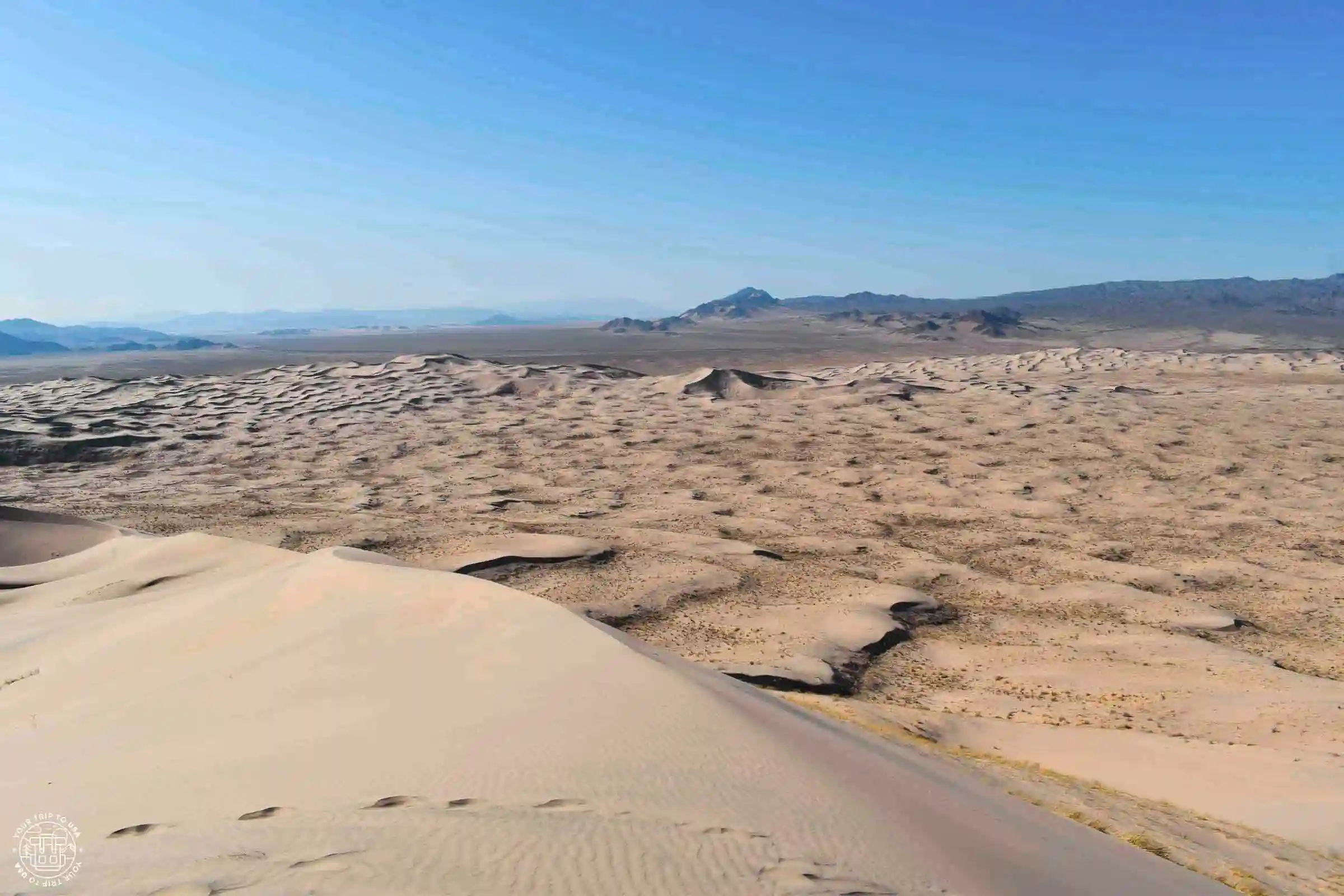
This place was a real surprise for us, and we can't recommend it enough! Located south of Death Valley, here you can enjoy a landscape with Joshua trees, volcanoes and sand dunes. It's spectacular. 😍
If you have time and it's not too hot, we recommend climbing the Kelso Dunes. You can reach the summit of these sand dunes by following a 2.5-kilometer (1.5 mi) trail. We won't lie to you, the last part is tough because your feet sink into the sand, but when you reach the top, the landscape will leave you speechless.
6. Palm Springs Aerial Tramway
If you pass through Palm Springs during your visit to Joshua Tree, the city with the closest airport to the park, it may be a good idea to ride the Palm Springs Aerial Tramway. This cable car is considered one of the largest in the world and climbs 1,700 meters (5,580 ft) in just 10 minutes, ascending through Chino Canyon from the base of the Coachella Valley to the mountains of Mt. San Jacinto State Park.
The cabins rotate, so during the ride you'll have panoramic views of the entire surroundings, passing through different types of landscapes. At the upper station, located at an altitude of over 2,500 meters (8,200 ft), you can enjoy viewpoints, eat at its restaurants, or go hiking in the state park.
💸 If you book your tickets through here, they will be $2 cheaper per person than if you do so on the official website, as you won't be charged the online purchase fee.
7. Mecca Hills Wilderness
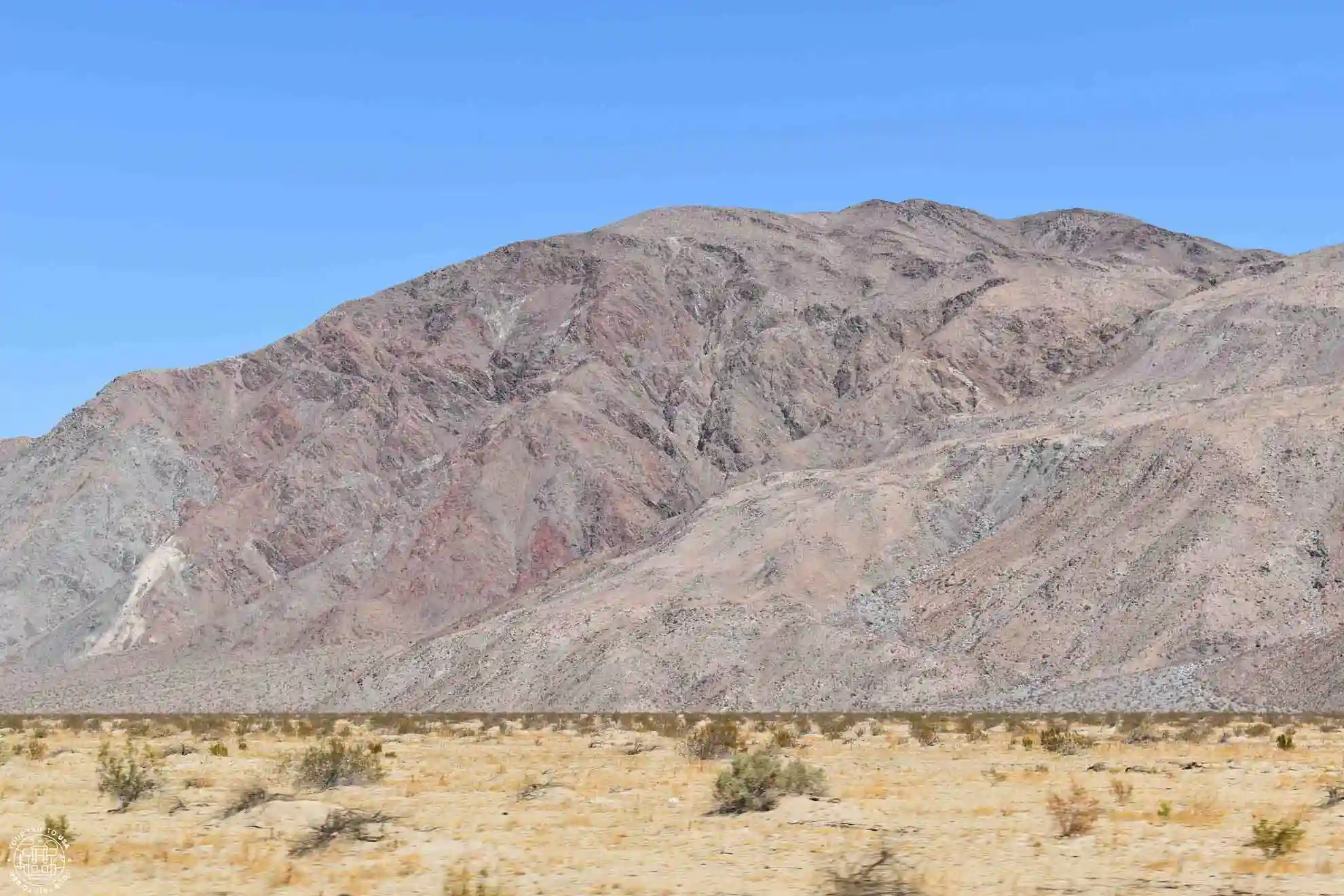
The Mecca Hills are located near the southern entrance to Joshua Tree National Park and are characterized by their spectacular, colorful canyons formed by the San Andreas fault, as well as their geological formations.
The main attraction here is Painted Canyon, a canyon with layers of different colors reminiscent of a painter's palette, similar to Artists Palette in Death Valley. The visit can be combined with the popular Ladder Canyon Trail, which takes you through slot canyons with the help of ladders to overcome the uneven terrain. It's a moderate and long hike, about 10 km (6 mi), so it's recommended not to do it in summer and to bring plenty of water.
8. Anza Borrego Desert State Park
This state park, the largest in California, is located between San Diego and Joshua Tree National Park. Anza-Borrego Desert State Park has one of the most impressive desert landscapes in Southern California, with rugged canyons such as Coyote Canyon, mountains, and oases of palm trees and fruit trees.
The origin of its name is quite curious: Anza comes from the Spanish explorer Juan Bautista de Anza, and Borrego comes from the desert bighorn sheep (called borrego cimarrón in Spanish), one of the most emblematic animals of these arid areas.
The best time to visit Anza Borrego is during spring (which in the desert runs from mid-February to early March), when the desert blooms in thousands of colorful flowers after a rainy winter.
9. Salton Sea
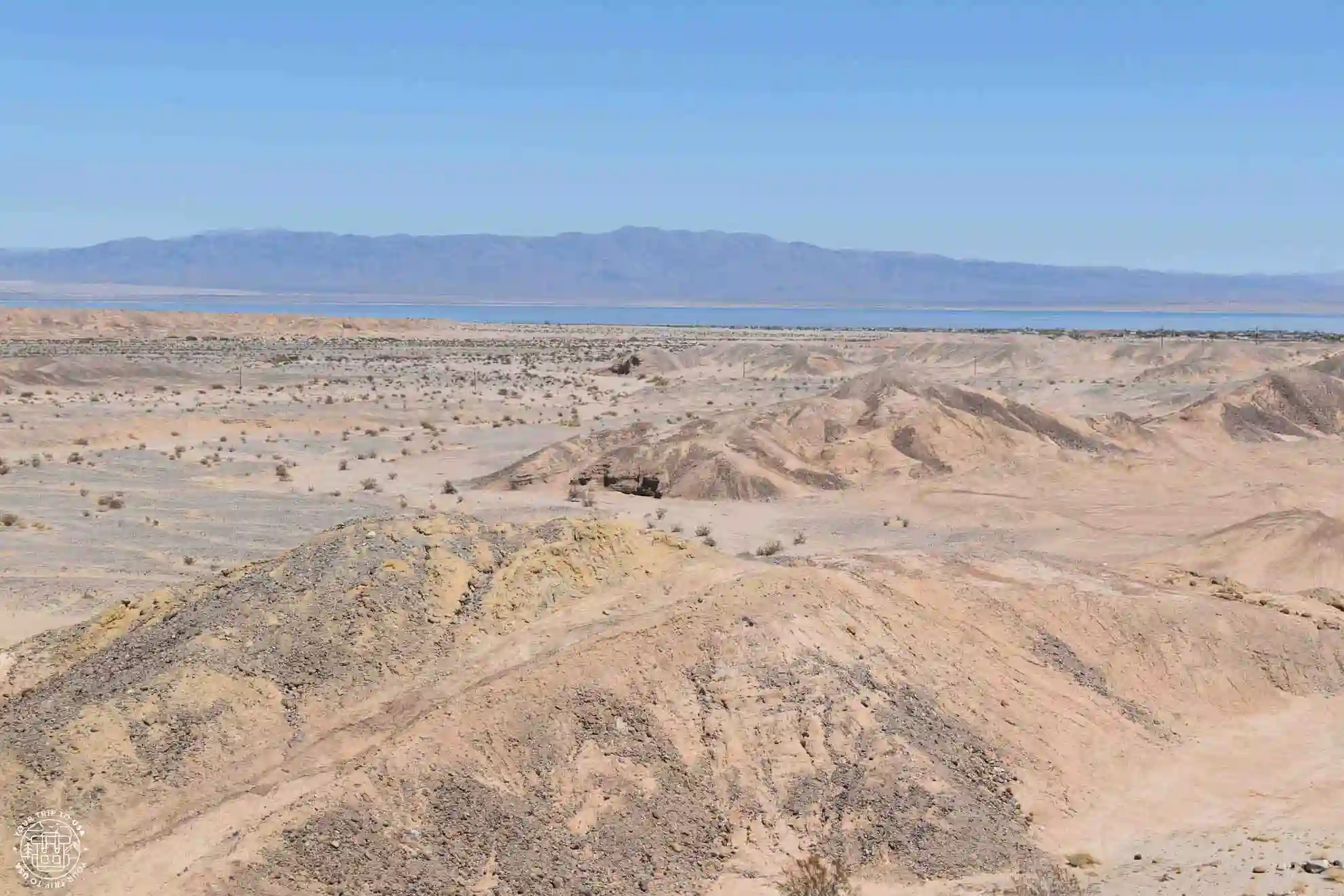
The Salton Sea, located between the southern entrance to Joshua Tree and Anza Borrego, is the largest lake in the state of California. This salt lake was accidentally formed in 1905 when a flood of the Colorado River inundated irrigation canals for several years. Over time, the Salton Sea became a popular tourist destination with hotels, harbors, and resorts, especially during the 1950s and 1960s.
Increased salinity, decreased water flow, and environmental problems caused the area to decline, leaving partially abandoned towns such as Bombay Beach, where you can see piles of rusty cars and other ruins. Even so, the Salton Sea is a key location for Pacific migratory birds and, without a doubt, an interesting place to photograph.
Map of places to see in Joshua Tree and surroundings
All the places we've told you about and the different hikes are marked on this map to make it easier for you to find them:
FAQs about things to do in Joshua Tree National Park
What are the must-see sights in Joshua Tree?
The places you can’t miss are Hidden Valley, Cap Rock, Keys View, Skull Rock, Arch Rock & Heart Rock, and Cholla Cactus Garden.
How many days do you need to visit Joshua Tree National Park?
You can see the must-see sights in one day, but ideally, you should spend two days to explore at a more leisurely pace.
What to see in Joshua Tree in one day?
In one day, you can take a very comprehensive route passing through Hidden Valley, Barker Dam, Wall Street Mill, Cap Rock, Keys View, Skull Rock, Arch Rock & Heart Rock, Cholla Cactus Garden, Ocotillo Patch, Sky’s the Limit, Oasis of Mara, and stargazing at night.
When is the best time to visit Joshua Tree?
The best time is from October to April. In summer, temperatures can be extremely high.
What is the best time of day to visit Joshua Tree?
Sunrise and sunset are the best times due to the light and milder temperatures.
Do you need a car to visit Joshua Tree?
Yes, it’s essential, as there is no public transportation within the park.
What are the best hikes in Joshua Tree?
Some of the most popular trails are Hidden Valley, Arch Rock & Heart Rock, and Barker Dam.
Can you visit Joshua Tree with children?
Yes, there are many accessible areas and easy trails, making it a family-friendly destination.
We hope you enjoy everything there is to see in Joshua Tree! 🌵